Altum HR Insights

How to Handle a Grievance at Work: A Professional Guide for UK Employers

Jul 3, 2026 | HR Insights

Did you know that an administrative slip-up during a staff dispute could now leave your business vulnerable for twice as long as it used to? With the Employment Tribunal claim time limit increasing to six months as of October 2026, learning how to handle a grievance at work has never been more critical for your peace of mind. We recognise that receiving a formal complaint often brings a wave of anxiety, especially when you’re balancing the nuances of the ACAS Code against the daily demands of running a company. It’s a stressful position to be in, but it’s also an opportunity to demonstrate your commitment to a fair and professional environment.

We’re here to help you master the legal complexities of the UK grievance process so you can protect your business and maintain a productive workplace culture. This guide provides a clear roadmap through the essential procedural steps, from the initial investigation to the final appeal. We’ll also explore how the latest 2026 regulatory shifts, including the new duty to take all reasonable steps to prevent harassment, impact your internal investigations and long-term stability. By following a structured, empathetic approach, you can resolve conflict with confidence and keep your focus where it belongs: on the growth of your enterprise.

Key Takeaways

  • Understand the legal weight of the ACAS Code of Practice and why treating every formal concern with gravity is essential for regulatory compliance.
  • Learn exactly how to handle a grievance at work using a step-by-step framework that ensures impartiality and protects your business from procedural errors.
  • Gain clarity on conducting professional hearings, including the statutory right for employees to be accompanied and the importance of a neutral environment.
  • Master the “balance of probabilities” standard for evidence evaluation to ensure your final decisions and appeal processes are legally robust.
  • Discover how expert on-site HR support can act as a stabilising force, resolving interpersonal friction before it reaches an Employment Tribunal.

What is a Grievance and Why Must Employers Take it Seriously?

At its core, a grievance is a formal signal that something in the workplace has gone wrong. Whilst many managers view them as a bureaucratic hurdle, we see them as an essential feedback loop. Understanding What is a Grievance involves recognising it as any formal concern, problem, or complaint raised by an employee regarding their work, workplace, or colleagues. It’s the moment an employee moves beyond a casual moan and asks for a structured resolution to an issue affecting their professional life.

Taking these complaints seriously isn’t just about good management; it’s a legal necessity. The ACAS Code of Practice on Disciplinary and Grievance Procedures provides the gold standard for these interactions. Although the Code itself isn’t strictly law, Employment Tribunals must take it into account. If you’re found to have unreasonably failed to follow its guidance, a tribunal can increase any compensation awarded against you by up to 25%. Ignoring a grievance often leads to claims of constructive dismissal or discrimination, which can be devastating for both your reputation and your balance sheet.

Distinguishing between “grumbles” and formal grievances is the first step in learning how to handle a grievance at work effectively. A grumble is often a fleeting frustration shared in the breakroom. A grievance is a specific request for change. When an employee puts their concerns in writing or explicitly asks for a formal meeting, the clock starts ticking on your legal obligations.

Informal vs Formal: When to Escalate

We always encourage resolving issues through quiet conversation or internal mediation where possible. These informal routes often preserve working relationships that a formal process might strain. However, you must identify the “trigger point” where an informal chat is no longer sufficient. If the issue involves allegations of harassment, safety risks, or if the employee is clearly unsatisfied with an informal outcome, you must escalate to a formal process immediately. Always document informal resolutions; a brief email confirming what was agreed can prevent a settled issue from resurfacing as a formal claim later.

The Role of Your Internal Grievance Policy

Having a bespoke policy is far superior to relying on generic internet templates. Your policy should act as a clear, accessible roadmap for your staff, demonstrating transparency and fairness from the outset. It’s vital that this document isn’t a standalone file gathering dust. By linking your procedure to your wider HR policies and contracts, you ensure total compliance across the organisation. A well-integrated policy tells your team that you have a structured, reliable method for how to handle a grievance at work, which builds the psychological security necessary for a high-performing culture.

The Formal Grievance Procedure: A Step-by-Step Framework

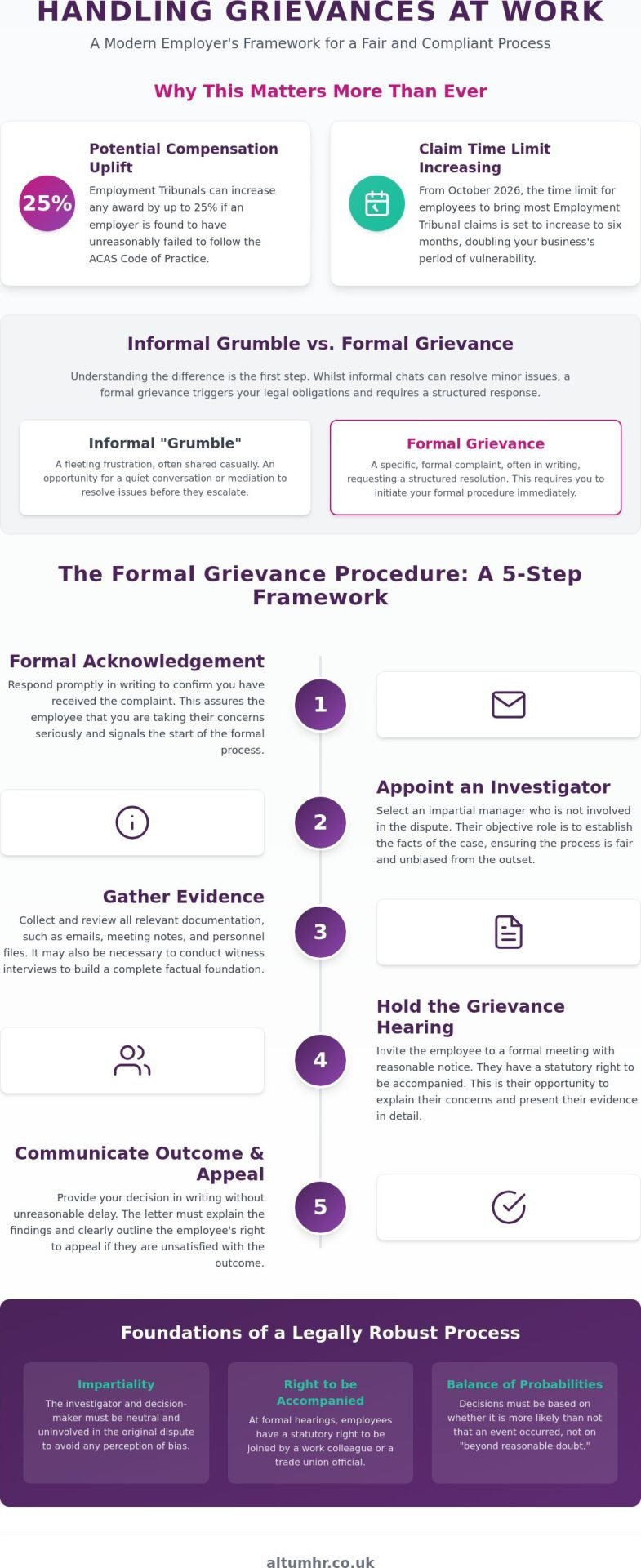
Once an issue escalates beyond an informal chat, you must transition into a structured, transparent process. Knowing how to handle a grievance at work requires a methodical approach that balances legal compliance with human empathy. This framework ensures that every party feels heard whilst protecting the organisation from claims of procedural unfairness. Following these five steps will help you maintain control of the situation:

  • Step 1: Formal Acknowledgement. Respond to the grievance in writing immediately. This confirms you’ve received the complaint and are taking it seriously.
  • Step 2: Appointing an Investigator. Select an impartial manager who isn’t involved in the dispute. Their role is to remain objective throughout the process.
  • Step 3: Gathering Evidence. Collect all relevant documentation, including emails, meeting logs, and witness statements, to build a factual foundation.
  • Step 4: The Grievance Hearing. Invite the employee to a formal meeting with reasonable notice. This gives them the opportunity to explain their concerns in detail.
  • Step 5: Outcome and Appeal. Communicate your decision in writing and clearly outline the employee’s right to appeal if they’re unsatisfied with the result.

If you find the administrative burden of these steps overwhelming, our grievance procedures support can help you manage the paperwork and ensure every deadline is met with precision.

Conducting a Thorough Investigation

The integrity of your entire process rests on the quality of your investigation. It’s vital to establish the facts before forming any conclusions or taking action. When dealing with sensitive evidence, such as private messages or health data, you must maintain strict confidentiality to protect the privacy of all involved. The investigator acts as a neutral fact-finder whose purpose is to gather objective evidence rather than to sit in judgement of the parties involved. This distinction ensures that the final decision-maker has a clear, unbiased report to work from.

Timescales and Delays: What is “Reasonable”?

While the ACAS Code doesn’t set a strict “stopwatch” for grievances, it demands action without unreasonable delay. Understanding how to raise a formal grievance from the employee’s perspective helps managers appreciate the anxiety caused by silence. If complex evidence gathering or staff absence causes a hold-up, keep the employee informed with regular updates. Procrastination creates frustration and legal risk, yet rushing the process can lead to overlooked facts. Aim for a pace that feels thorough but maintains momentum, usually aiming to conclude the initial investigation within two to four weeks depending on the case’s complexity.

Conducting the Grievance Hearing Professionally

Moving from the preparatory phase to the actual meeting is often where managers feel the most pressure. Learning how to handle a grievance at work effectively involves more than just following a checklist; it requires mastering the art of the formal hearing. This is the employee’s opportunity to feel heard and your opportunity to gather the nuanced information that written documents might miss. To ensure the process remains robust, we recommend choosing a neutral, private location away from the distractions of the main office. This physical setting provides the psychological safety necessary for an open, honest discussion.

A professional hearing follows a logical, rhythmic progression. Begin with clear introductions and explain the purpose of the meeting before inviting the employee to state their grievance in their own words. Your role here is to listen actively and use open-ended questioning to explore the root causes of their concern. We suggest referring to the Acas guide to discipline and grievances to ensure your meeting structure remains aligned with national standards. Crucially, you should never attempt to lead a hearing whilst also trying to record the minutes. A dedicated note-taker is essential to create a contemporaneous record, allowing you to focus entirely on the dialogue and the individual’s behaviour.

Managing the Right to be Accompanied

Under UK law, employees have a statutory right to be accompanied by a fellow colleague or a trade union representative. This companion plays a specific role; they can address the hearing to put the employee’s case, sum up that case, and respond on the employee’s behalf to any views expressed. However, they do not have the right to answer questions that are put directly to the employee. Whilst you may occasionally receive requests for legal representation or family members to attend, these are generally not a legal right at this stage. Handling these requests with a firm but polite explanation of your company policy helps maintain the professional boundaries of the process.

Dealing with High Emotions and Conflict

Grievances are inherently emotive, and it’s common for meetings to become charged with stress or frustration. Our approach is to maintain a calm, reliable presence that de-escalates tension before it disrupts the process. If behaviour becomes unproductive or overly aggressive, don’t hesitate to adjourn the meeting for a short break. A fifteen-minute pause often allows everyone to regain their composure. Throughout the discussion, you must remain an objective fact-finder. Avoid taking sides or offering immediate opinions, as your goal is to conclude the hearing with a complete understanding of the situation, rather than an instant verdict.

Decision Making, Outcomes, and the Right to Appeal

Reaching a decision is the most critical phase of the process. Unlike criminal courts that require proof “beyond reasonable doubt,” employment law operates on the “balance of probabilities.” This means you must decide whether it is more likely than not that the incident occurred as described. When considering how to handle a grievance at work, this distinction is vital. It allows you to make a firm decision based on a reasonable belief formed after a thorough investigation, even if absolute proof is elusive.

Your final conclusion will typically fall into one of three categories:

  • Upheld: You agree with the employee’s complaint and will take remedial action.
  • Partially Upheld: You find merit in certain aspects of the grievance but not others. For instance, you might agree that a process was followed incorrectly whilst finding no evidence of the alleged discriminatory intent.
  • Not Upheld: You find no evidence to support the claims made after a full review of the facts.

Once you’ve reached a verdict, you must craft an outcome letter that is clear, professional, and directly linked to the evidence gathered. This document should explain your reasoning for each point raised, ensuring the employee understands the “why” behind your decision. Crucially, you have a statutory requirement to offer the employee the right to appeal your decision. If you’re unsure about the legal implications of your findings, our disciplinary and grievance support provides the expert oversight needed to protect your organisation from future claims.

Implementing Remedial Actions

An “Upheld” grievance shouldn’t be seen as a failure; it’s a catalyst for positive organisational change. We often view grievances as an early warning system for wider cultural issues that need addressing. Depending on your findings, your response might involve bespoke training for a specific team, updates to your internal handbook, or a formal apology to the aggrieved party. In some cases, you may need to link the outcome to performance management if the investigation revealed that a manager’s conduct fell below the standards you expect for your business.

The Appeal Process: Ensuring Final Fairness

The appeal acts as a final safeguard against procedural errors or perceived bias. To maintain total impartiality, the appeal should be heard by someone not previously involved in the case, ideally a more senior manager or an external consultant. Understanding how to handle a grievance at work also means recognising that the appeal decision represents the end of your internal journey. Employees usually appeal on the grounds of new evidence, procedural flaws, or a belief that the outcome was simply unfair. Once the appeal hearing is concluded and the final decision is issued in writing, the internal process is officially closed, providing the closure needed for the organisation to move forward.
How to Handle a Grievance at Work: A Professional Guide for UK Employers

Why Expert HR Support is Your Best Defence Against Claims

Even with a firm grasp of how to handle a grievance at work, the practical execution carries significant risk. A common pitfall for many businesses is focusing solely on the “fairness” of the outcome whilst overlooking the rigid procedural requirements of the ACAS Code. If an employment tribunal reviews your case, they won’t just look at what you decided; they’ll scrutinise every letter, meeting, and minute to ensure the process was impeccable. A procedural slip-up, however minor it may seem, can turn a justifiable decision into a costly legal defeat.

We provide a stabilising force for leaders caught in the middle of interpersonal friction. By introducing an external expert, you demonstrate a commitment to total impartiality that is difficult to achieve internally. This “fresh pair of eyes” is particularly valuable in sensitive or complex disputes where existing relationships might cloud a manager’s judgement. Our role is to ensure that every step of your journey is documented, compliant, and ethically grounded, allowing you to move from conflict to resolution with absolute confidence.

The Altum HR Approach to Grievances

We don’t believe in one-size-fits-all templates. Instead, we develop bespoke grievance procedures that reflect the unique culture and structure of your organisation. Our consultants can conduct the full investigation, interview witnesses, and chair the hearings on your behalf. This level of detachment is vital for maintaining psychological security within the wider team. We also ensure your business remains fully compliant with the significant shifts in UK employment law 2026. With the tribunal claim window extending to six months and new duties regarding the prevention of third-party harassment, the margin for error has effectively disappeared.

Reducing the Burden on Management

Managing a formal complaint is an exhausting, time-consuming task. It pulls leadership away from strategic growth and into the weeds of administrative detail. By utilising our on-site HR support, you can delegate the heavy lifting to seasoned experts who have navigated every possible workplace scenario. Our fractional outsourced HR services act as a long-term partner for your stability, providing the peace of mind that comes from professional indemnity and reliable, expert-led advice. Ultimately, knowing how to handle a grievance at work is about more than just avoiding litigation; it’s about fostering a workplace where issues are resolved with such thoroughness that your team feels secure, respected, and ready to move forward together.

Securing Your Workplace Future Through Procedural Excellence

Managing workplace conflict doesn’t have to be a source of constant anxiety for your leadership team. By following the structured ACAS framework and maintaining a transparent, evidence-led approach, you can transform a challenging internal dispute into a catalyst for organisational stability. We’ve explored the necessity of impartial investigations and the critical importance of meeting statutory appeal requirements to insulate your business from litigation risk. Ultimately, mastering how to handle a grievance at work is about protecting your people and your reputation through every stage of the professional journey.

If you’re currently facing a complex dispute or simply want to ensure your internal policies are future-proofed against the 2026 regulatory shifts, we’re ready to stand alongside you. Secure your business today with expert Grievance Support from Altum HR. Our consultants provide expert employment law advice, on-site hearing support, and ACAS-compliant process management to give you total peace of mind. You don’t have to navigate these legal complexities alone; with a dedicated partner, you can maintain a productive workplace culture whilst ensuring your enterprise remains robust and compliant. We look forward to helping you build a more resilient organisation.

Frequently Asked Questions

Do I have to follow the ACAS Code of Practice for every grievance?

You must follow the ACAS Code for every formal grievance raised by an employee. While it isn’t strictly law, an Employment Tribunal will check your compliance if a claim arises. If they find you’ve unreasonably failed to follow the Code, they can increase any compensation awarded to the employee by up to 25%. This financial risk makes the Code the essential foundation for learning how to handle a grievance at work effectively.

Can an employee bring a lawyer to a grievance hearing?

Employees do not have a statutory right to bring a lawyer to a grievance hearing. Under UK law, the right to be accompanied is limited to a workplace colleague or a trade union representative. Whilst you can choose to allow a solicitor or a family member in exceptional circumstances, most employers stick to the statutory limits to maintain a professional, internal atmosphere and avoid unnecessary legal escalation at the hearing stage.

What happens if an employee raises a grievance during a disciplinary process?

You have the discretion to either pause the disciplinary process or run both procedures concurrently. If the grievance and disciplinary issues are deeply related, it’s often more efficient to deal with them together. However, if the grievance suggests the disciplinary action is biased or retaliatory, pausing to investigate the complaint first is often the safest route to ensure your final decision remains legally robust and procedurally fair.

How long does an employer have to respond to a formal grievance?

You should respond to a formal grievance without unreasonable delay. While there is no fixed number of days set in stone, best practice involves acknowledging the complaint within 24 to 48 hours. You should then aim to hold the hearing within five to ten working days. Keeping the process moving prevents the situation from festering and demonstrates your commitment to how to handle a grievance at work with professional diligence.

Can a grievance be handled by the employee’s direct line manager?

A direct line manager can handle a grievance as long as they are not the subject of the complaint. If the employee is raising concerns about their manager’s behaviour or decisions, you must appoint a different, impartial manager to lead the investigation. Using a manager from a separate department or an external consultant ensures the process remains objective and protects the integrity of your eventual decision.

What should I do if the employee refuses to attend the grievance hearing?

You should attempt to rearrange the meeting at least once if an employee fails to attend. If they continue to refuse without a valid medical or personal reason, you may eventually have to proceed in their absence. In these cases, make your decision based on the written evidence and any witness statements available. Always document your attempts to facilitate their attendance to show the tribunal you acted reasonably.

Is it possible for a former employee to raise a grievance?

Former employees can raise grievances, though your legal obligations change once the contract has ended. The ACAS Code technically only applies to current employees, but ignoring a complaint from a leaver is risky. Investigating their concerns can help you identify underlying culture issues and may even head off a potential tribunal claim before it’s filed. We recommend responding professionally to protect your brand’s reputation and long-term stability.

What is the difference between a grievance and a whistleblowing claim?

The primary difference lies in whose interest the complaint serves. A grievance is typically a personal matter, such as a dispute over individual pay or a conflict with a colleague. Whistleblowing involves a “protected disclosure” regarding a matter of public interest, such as criminal activity, health and safety breaches, or environmental damage. Whistleblowers receive specific legal protections that differ from those provided in standard grievance procedures.

Josephine Broadstock

Article by

Josephine Broadstock

Josephine Broadstock is the Founder of Altum HR and a recognised thought leader in HR strategy and operational delivery. With a career grounded in employment law and hands-on business support, Josie has built a reputation for helping organisations move beyond transactional HR into truly strategic, commercially aligned people management.At the core of Josie’s approach is a belief that HR should not sit in isolation—it should actively drive business performance. She works closely with business owners and leadership teams to understand how their organisations function in practice, not just on paper, enabling the design and implementation of people strategies that are both legally robust and operationally effective.Josie specialises in translating complex employment law and HR challenges into clear, practical solutions that support growth, reduce risk, and improve organisational efficiency. Her work often focuses on bridging the gap between policy and execution—ensuring that processes are not only compliant but also embedded into day-to-day operations in a way that adds measurable value.Through Altum HR, Josephine leads a team of highly qualified consultants who share her commitment to quality, personalisation, and commercial impact. She is particularly passionate about raising standards within the HR industry, advocating for a more consultative, expert-led approach that prioritises long-term business outcomes over quick fixes.As an author, Josie shares insights on employment law developments, operational best practice, and real-world HR challenges, offering business leaders practical guidance they can apply immediately. Her content is designed to cut through complexity and provide clarity in an ever-evolving workplace landscape.

Disclaimer

DisclaimerThe content on this blog is provided for general informational and educational purposes only and does not constitute professional advice. While we strive to ensure information is accurate and up to date, we make no warranties or representations about the completeness, accuracy, reliability, suitability, or availability of the information, products, services, or related graphics contained on the blog. Any reliance you place on such information is strictly at your own risk. We accept no liability for any loss or damage arising from the use of this blog or reliance on its content.No Professional RelationshipUse of this blog does not create a professional client relationship between you and Altum HR. For personalised advice, please consult a qualified professional in the relevant field.Third‑Party Links and ContentThis blog may contain links to third‑party websites, products, or services. Links are provided for convenience only and do not imply endorsement. We are not responsible for the content, privacy practices, or accuracy of third‑party sites and accept no liability for any loss or damage arising from their use.Affiliate and Sponsored ContentWhere applicable, we may receive compensation for products or services mentioned. We only recommend products we believe in, but you should perform your own due diligence before purchasing.Intellectual PropertyAll content on this blog is protected by copyright unless otherwise stated. You may not reproduce, distribute, or create derivative works from our content without prior written permission.Governing LawThis disclaimer and any dispute arising out of or in connection with the blog are governed by the laws of England and Wales.

Did you know that an administrative slip-up during a staff dispute could now leave your business vulnerable for twice as long as it used to? With the Employment Tribunal claim time limit increasing to six months as of October 2026, learning how to handle a grievance at work has never been more critical for your peace of mind. We recognise that receiving a formal complaint often brings a wave of anxiety, especially when you’re balancing the nuances of the ACAS Code against the daily demands of running a company. It’s a stressful position to be in, but it’s also an opportunity to demonstrate your commitment to a fair and professional environment.

We’re here to help you master the legal complexities of the UK grievance process so you can protect your business and maintain a productive workplace culture. This guide provides a clear roadmap through the essential procedural steps, from the initial investigation to the final appeal. We’ll also explore how the latest 2026 regulatory shifts, including the new duty to take all reasonable steps to prevent harassment, impact your internal investigations and long-term stability. By following a structured, empathetic approach, you can resolve conflict with confidence and keep your focus where it belongs: on the growth of your enterprise.

Key Takeaways

  • Understand the legal weight of the ACAS Code of Practice and why treating every formal concern with gravity is essential for regulatory compliance.
  • Learn exactly how to handle a grievance at work using a step-by-step framework that ensures impartiality and protects your business from procedural errors.
  • Gain clarity on conducting professional hearings, including the statutory right for employees to be accompanied and the importance of a neutral environment.
  • Master the “balance of probabilities” standard for evidence evaluation to ensure your final decisions and appeal processes are legally robust.
  • Discover how expert on-site HR support can act as a stabilising force, resolving interpersonal friction before it reaches an Employment Tribunal.

What is a Grievance and Why Must Employers Take it Seriously?

At its core, a grievance is a formal signal that something in the workplace has gone wrong. Whilst many managers view them as a bureaucratic hurdle, we see them as an essential feedback loop. Understanding What is a Grievance involves recognising it as any formal concern, problem, or complaint raised by an employee regarding their work, workplace, or colleagues. It’s the moment an employee moves beyond a casual moan and asks for a structured resolution to an issue affecting their professional life.

Taking these complaints seriously isn’t just about good management; it’s a legal necessity. The ACAS Code of Practice on Disciplinary and Grievance Procedures provides the gold standard for these interactions. Although the Code itself isn’t strictly law, Employment Tribunals must take it into account. If you’re found to have unreasonably failed to follow its guidance, a tribunal can increase any compensation awarded against you by up to 25%. Ignoring a grievance often leads to claims of constructive dismissal or discrimination, which can be devastating for both your reputation and your balance sheet.

Distinguishing between “grumbles” and formal grievances is the first step in learning how to handle a grievance at work effectively. A grumble is often a fleeting frustration shared in the breakroom. A grievance is a specific request for change. When an employee puts their concerns in writing or explicitly asks for a formal meeting, the clock starts ticking on your legal obligations.

Informal vs Formal: When to Escalate

We always encourage resolving issues through quiet conversation or internal mediation where possible. These informal routes often preserve working relationships that a formal process might strain. However, you must identify the “trigger point” where an informal chat is no longer sufficient. If the issue involves allegations of harassment, safety risks, or if the employee is clearly unsatisfied with an informal outcome, you must escalate to a formal process immediately. Always document informal resolutions; a brief email confirming what was agreed can prevent a settled issue from resurfacing as a formal claim later.

The Role of Your Internal Grievance Policy

Having a bespoke policy is far superior to relying on generic internet templates. Your policy should act as a clear, accessible roadmap for your staff, demonstrating transparency and fairness from the outset. It’s vital that this document isn’t a standalone file gathering dust. By linking your procedure to your wider HR policies and contracts, you ensure total compliance across the organisation. A well-integrated policy tells your team that you have a structured, reliable method for how to handle a grievance at work, which builds the psychological security necessary for a high-performing culture.

The Formal Grievance Procedure: A Step-by-Step Framework

Once an issue escalates beyond an informal chat, you must transition into a structured, transparent process. Knowing how to handle a grievance at work requires a methodical approach that balances legal compliance with human empathy. This framework ensures that every party feels heard whilst protecting the organisation from claims of procedural unfairness. Following these five steps will help you maintain control of the situation:

  • Step 1: Formal Acknowledgement. Respond to the grievance in writing immediately. This confirms you’ve received the complaint and are taking it seriously.
  • Step 2: Appointing an Investigator. Select an impartial manager who isn’t involved in the dispute. Their role is to remain objective throughout the process.
  • Step 3: Gathering Evidence. Collect all relevant documentation, including emails, meeting logs, and witness statements, to build a factual foundation.
  • Step 4: The Grievance Hearing. Invite the employee to a formal meeting with reasonable notice. This gives them the opportunity to explain their concerns in detail.
  • Step 5: Outcome and Appeal. Communicate your decision in writing and clearly outline the employee’s right to appeal if they’re unsatisfied with the result.

If you find the administrative burden of these steps overwhelming, our grievance procedures support can help you manage the paperwork and ensure every deadline is met with precision.

Conducting a Thorough Investigation

The integrity of your entire process rests on the quality of your investigation. It’s vital to establish the facts before forming any conclusions or taking action. When dealing with sensitive evidence, such as private messages or health data, you must maintain strict confidentiality to protect the privacy of all involved. The investigator acts as a neutral fact-finder whose purpose is to gather objective evidence rather than to sit in judgement of the parties involved. This distinction ensures that the final decision-maker has a clear, unbiased report to work from.

Timescales and Delays: What is “Reasonable”?

While the ACAS Code doesn’t set a strict “stopwatch” for grievances, it demands action without unreasonable delay. Understanding how to raise a formal grievance from the employee’s perspective helps managers appreciate the anxiety caused by silence. If complex evidence gathering or staff absence causes a hold-up, keep the employee informed with regular updates. Procrastination creates frustration and legal risk, yet rushing the process can lead to overlooked facts. Aim for a pace that feels thorough but maintains momentum, usually aiming to conclude the initial investigation within two to four weeks depending on the case’s complexity.

Conducting the Grievance Hearing Professionally

Moving from the preparatory phase to the actual meeting is often where managers feel the most pressure. Learning how to handle a grievance at work effectively involves more than just following a checklist; it requires mastering the art of the formal hearing. This is the employee’s opportunity to feel heard and your opportunity to gather the nuanced information that written documents might miss. To ensure the process remains robust, we recommend choosing a neutral, private location away from the distractions of the main office. This physical setting provides the psychological safety necessary for an open, honest discussion.

A professional hearing follows a logical, rhythmic progression. Begin with clear introductions and explain the purpose of the meeting before inviting the employee to state their grievance in their own words. Your role here is to listen actively and use open-ended questioning to explore the root causes of their concern. We suggest referring to the Acas guide to discipline and grievances to ensure your meeting structure remains aligned with national standards. Crucially, you should never attempt to lead a hearing whilst also trying to record the minutes. A dedicated note-taker is essential to create a contemporaneous record, allowing you to focus entirely on the dialogue and the individual’s behaviour.

Managing the Right to be Accompanied

Under UK law, employees have a statutory right to be accompanied by a fellow colleague or a trade union representative. This companion plays a specific role; they can address the hearing to put the employee’s case, sum up that case, and respond on the employee’s behalf to any views expressed. However, they do not have the right to answer questions that are put directly to the employee. Whilst you may occasionally receive requests for legal representation or family members to attend, these are generally not a legal right at this stage. Handling these requests with a firm but polite explanation of your company policy helps maintain the professional boundaries of the process.

Dealing with High Emotions and Conflict

Grievances are inherently emotive, and it’s common for meetings to become charged with stress or frustration. Our approach is to maintain a calm, reliable presence that de-escalates tension before it disrupts the process. If behaviour becomes unproductive or overly aggressive, don’t hesitate to adjourn the meeting for a short break. A fifteen-minute pause often allows everyone to regain their composure. Throughout the discussion, you must remain an objective fact-finder. Avoid taking sides or offering immediate opinions, as your goal is to conclude the hearing with a complete understanding of the situation, rather than an instant verdict.

Decision Making, Outcomes, and the Right to Appeal

Reaching a decision is the most critical phase of the process. Unlike criminal courts that require proof “beyond reasonable doubt,” employment law operates on the “balance of probabilities.” This means you must decide whether it is more likely than not that the incident occurred as described. When considering how to handle a grievance at work, this distinction is vital. It allows you to make a firm decision based on a reasonable belief formed after a thorough investigation, even if absolute proof is elusive.

Your final conclusion will typically fall into one of three categories:

  • Upheld: You agree with the employee’s complaint and will take remedial action.
  • Partially Upheld: You find merit in certain aspects of the grievance but not others. For instance, you might agree that a process was followed incorrectly whilst finding no evidence of the alleged discriminatory intent.
  • Not Upheld: You find no evidence to support the claims made after a full review of the facts.

Once you’ve reached a verdict, you must craft an outcome letter that is clear, professional, and directly linked to the evidence gathered. This document should explain your reasoning for each point raised, ensuring the employee understands the “why” behind your decision. Crucially, you have a statutory requirement to offer the employee the right to appeal your decision. If you’re unsure about the legal implications of your findings, our disciplinary and grievance support provides the expert oversight needed to protect your organisation from future claims.

Implementing Remedial Actions

An “Upheld” grievance shouldn’t be seen as a failure; it’s a catalyst for positive organisational change. We often view grievances as an early warning system for wider cultural issues that need addressing. Depending on your findings, your response might involve bespoke training for a specific team, updates to your internal handbook, or a formal apology to the aggrieved party. In some cases, you may need to link the outcome to performance management if the investigation revealed that a manager’s conduct fell below the standards you expect for your business.

The Appeal Process: Ensuring Final Fairness

The appeal acts as a final safeguard against procedural errors or perceived bias. To maintain total impartiality, the appeal should be heard by someone not previously involved in the case, ideally a more senior manager or an external consultant. Understanding how to handle a grievance at work also means recognising that the appeal decision represents the end of your internal journey. Employees usually appeal on the grounds of new evidence, procedural flaws, or a belief that the outcome was simply unfair. Once the appeal hearing is concluded and the final decision is issued in writing, the internal process is officially closed, providing the closure needed for the organisation to move forward.

How to Handle a Grievance at Work: A Professional Guide for UK Employers

Why Expert HR Support is Your Best Defence Against Claims

Even with a firm grasp of how to handle a grievance at work, the practical execution carries significant risk. A common pitfall for many businesses is focusing solely on the “fairness” of the outcome whilst overlooking the rigid procedural requirements of the ACAS Code. If an employment tribunal reviews your case, they won’t just look at what you decided; they’ll scrutinise every letter, meeting, and minute to ensure the process was impeccable. A procedural slip-up, however minor it may seem, can turn a justifiable decision into a costly legal defeat.

We provide a stabilising force for leaders caught in the middle of interpersonal friction. By introducing an external expert, you demonstrate a commitment to total impartiality that is difficult to achieve internally. This “fresh pair of eyes” is particularly valuable in sensitive or complex disputes where existing relationships might cloud a manager’s judgement. Our role is to ensure that every step of your journey is documented, compliant, and ethically grounded, allowing you to move from conflict to resolution with absolute confidence.

The Altum HR Approach to Grievances

We don’t believe in one-size-fits-all templates. Instead, we develop bespoke grievance procedures that reflect the unique culture and structure of your organisation. Our consultants can conduct the full investigation, interview witnesses, and chair the hearings on your behalf. This level of detachment is vital for maintaining psychological security within the wider team. We also ensure your business remains fully compliant with the significant shifts in UK employment law 2026. With the tribunal claim window extending to six months and new duties regarding the prevention of third-party harassment, the margin for error has effectively disappeared.

Reducing the Burden on Management

Managing a formal complaint is an exhausting, time-consuming task. It pulls leadership away from strategic growth and into the weeds of administrative detail. By utilising our on-site HR support, you can delegate the heavy lifting to seasoned experts who have navigated every possible workplace scenario. Our fractional outsourced HR services act as a long-term partner for your stability, providing the peace of mind that comes from professional indemnity and reliable, expert-led advice. Ultimately, knowing how to handle a grievance at work is about more than just avoiding litigation; it’s about fostering a workplace where issues are resolved with such thoroughness that your team feels secure, respected, and ready to move forward together.

Securing Your Workplace Future Through Procedural Excellence

Managing workplace conflict doesn’t have to be a source of constant anxiety for your leadership team. By following the structured ACAS framework and maintaining a transparent, evidence-led approach, you can transform a challenging internal dispute into a catalyst for organisational stability. We’ve explored the necessity of impartial investigations and the critical importance of meeting statutory appeal requirements to insulate your business from litigation risk. Ultimately, mastering how to handle a grievance at work is about protecting your people and your reputation through every stage of the professional journey.

If you’re currently facing a complex dispute or simply want to ensure your internal policies are future-proofed against the 2026 regulatory shifts, we’re ready to stand alongside you. Secure your business today with expert Grievance Support from Altum HR. Our consultants provide expert employment law advice, on-site hearing support, and ACAS-compliant process management to give you total peace of mind. You don’t have to navigate these legal complexities alone; with a dedicated partner, you can maintain a productive workplace culture whilst ensuring your enterprise remains robust and compliant. We look forward to helping you build a more resilient organisation.

Frequently Asked Questions

Do I have to follow the ACAS Code of Practice for every grievance?

You must follow the ACAS Code for every formal grievance raised by an employee. While it isn’t strictly law, an Employment Tribunal will check your compliance if a claim arises. If they find you’ve unreasonably failed to follow the Code, they can increase any compensation awarded to the employee by up to 25%. This financial risk makes the Code the essential foundation for learning how to handle a grievance at work effectively.

Can an employee bring a lawyer to a grievance hearing?

Employees do not have a statutory right to bring a lawyer to a grievance hearing. Under UK law, the right to be accompanied is limited to a workplace colleague or a trade union representative. Whilst you can choose to allow a solicitor or a family member in exceptional circumstances, most employers stick to the statutory limits to maintain a professional, internal atmosphere and avoid unnecessary legal escalation at the hearing stage.

What happens if an employee raises a grievance during a disciplinary process?

You have the discretion to either pause the disciplinary process or run both procedures concurrently. If the grievance and disciplinary issues are deeply related, it’s often more efficient to deal with them together. However, if the grievance suggests the disciplinary action is biased or retaliatory, pausing to investigate the complaint first is often the safest route to ensure your final decision remains legally robust and procedurally fair.

How long does an employer have to respond to a formal grievance?

You should respond to a formal grievance without unreasonable delay. While there is no fixed number of days set in stone, best practice involves acknowledging the complaint within 24 to 48 hours. You should then aim to hold the hearing within five to ten working days. Keeping the process moving prevents the situation from festering and demonstrates your commitment to how to handle a grievance at work with professional diligence.

Can a grievance be handled by the employee’s direct line manager?

A direct line manager can handle a grievance as long as they are not the subject of the complaint. If the employee is raising concerns about their manager’s behaviour or decisions, you must appoint a different, impartial manager to lead the investigation. Using a manager from a separate department or an external consultant ensures the process remains objective and protects the integrity of your eventual decision.

What should I do if the employee refuses to attend the grievance hearing?

You should attempt to rearrange the meeting at least once if an employee fails to attend. If they continue to refuse without a valid medical or personal reason, you may eventually have to proceed in their absence. In these cases, make your decision based on the written evidence and any witness statements available. Always document your attempts to facilitate their attendance to show the tribunal you acted reasonably.

Is it possible for a former employee to raise a grievance?

Former employees can raise grievances, though your legal obligations change once the contract has ended. The ACAS Code technically only applies to current employees, but ignoring a complaint from a leaver is risky. Investigating their concerns can help you identify underlying culture issues and may even head off a potential tribunal claim before it’s filed. We recommend responding professionally to protect your brand’s reputation and long-term stability.

What is the difference between a grievance and a whistleblowing claim?

The primary difference lies in whose interest the complaint serves. A grievance is typically a personal matter, such as a dispute over individual pay or a conflict with a colleague. Whistleblowing involves a “protected disclosure” regarding a matter of public interest, such as criminal activity, health and safety breaches, or environmental damage. Whistleblowers receive specific legal protections that differ from those provided in standard grievance procedures.

Josephine Broadstock

Article by

Josephine Broadstock

Josephine Broadstock is the Founder of Altum HR and a recognised thought leader in HR strategy and operational delivery. With a career grounded in employment law and hands-on business support, Josie has built a reputation for helping organisations move beyond transactional HR into truly strategic, commercially aligned people management.At the core of Josie’s approach is a belief that HR should not sit in isolation—it should actively drive business performance. She works closely with business owners and leadership teams to understand how their organisations function in practice, not just on paper, enabling the design and implementation of people strategies that are both legally robust and operationally effective.Josie specialises in translating complex employment law and HR challenges into clear, practical solutions that support growth, reduce risk, and improve organisational efficiency. Her work often focuses on bridging the gap between policy and execution—ensuring that processes are not only compliant but also embedded into day-to-day operations in a way that adds measurable value.Through Altum HR, Josephine leads a team of highly qualified consultants who share her commitment to quality, personalisation, and commercial impact. She is particularly passionate about raising standards within the HR industry, advocating for a more consultative, expert-led approach that prioritises long-term business outcomes over quick fixes.As an author, Josie shares insights on employment law developments, operational best practice, and real-world HR challenges, offering business leaders practical guidance they can apply immediately. Her content is designed to cut through complexity and provide clarity in an ever-evolving workplace landscape.

Disclaimer

DisclaimerThe content on this blog is provided for general informational and educational purposes only and does not constitute professional advice. While we strive to ensure information is accurate and up to date, we make no warranties or representations about the completeness, accuracy, reliability, suitability, or availability of the information, products, services, or related graphics contained on the blog. Any reliance you place on such information is strictly at your own risk. We accept no liability for any loss or damage arising from the use of this blog or reliance on its content.No Professional RelationshipUse of this blog does not create a professional client relationship between you and Altum HR. For personalised advice, please consult a qualified professional in the relevant field.Third‑Party Links and ContentThis blog may contain links to third‑party websites, products, or services. Links are provided for convenience only and do not imply endorsement. We are not responsible for the content, privacy practices, or accuracy of third‑party sites and accept no liability for any loss or damage arising from their use.Affiliate and Sponsored ContentWhere applicable, we may receive compensation for products or services mentioned. We only recommend products we believe in, but you should perform your own due diligence before purchasing.Intellectual PropertyAll content on this blog is protected by copyright unless otherwise stated. You may not reproduce, distribute, or create derivative works from our content without prior written permission.Governing LawThis disclaimer and any dispute arising out of or in connection with the blog are governed by the laws of England and Wales.

Call now for instant HR advice on 0800 048 5764 or WhatsApp 07432 275612.

How to Handle a Grievance at Work: A Professional Guide for UK Employers

Book an HR Consultation

From HR advice, policies to Employment Law, Redundancy Support and Employee Contracts - we can help. Leave your details below and we'll be in touch.


Your data will be processed inline with our privacy policy. We respect your right to privacy and continuously strive to ensure that all data that we collect and store is done so securely and is properly protected.