Altum HR Insights

Discrimination in the Workplace: A UK Employer’s Guide to the Equality Act 2010

Aug 29, 2026 | HR Insights

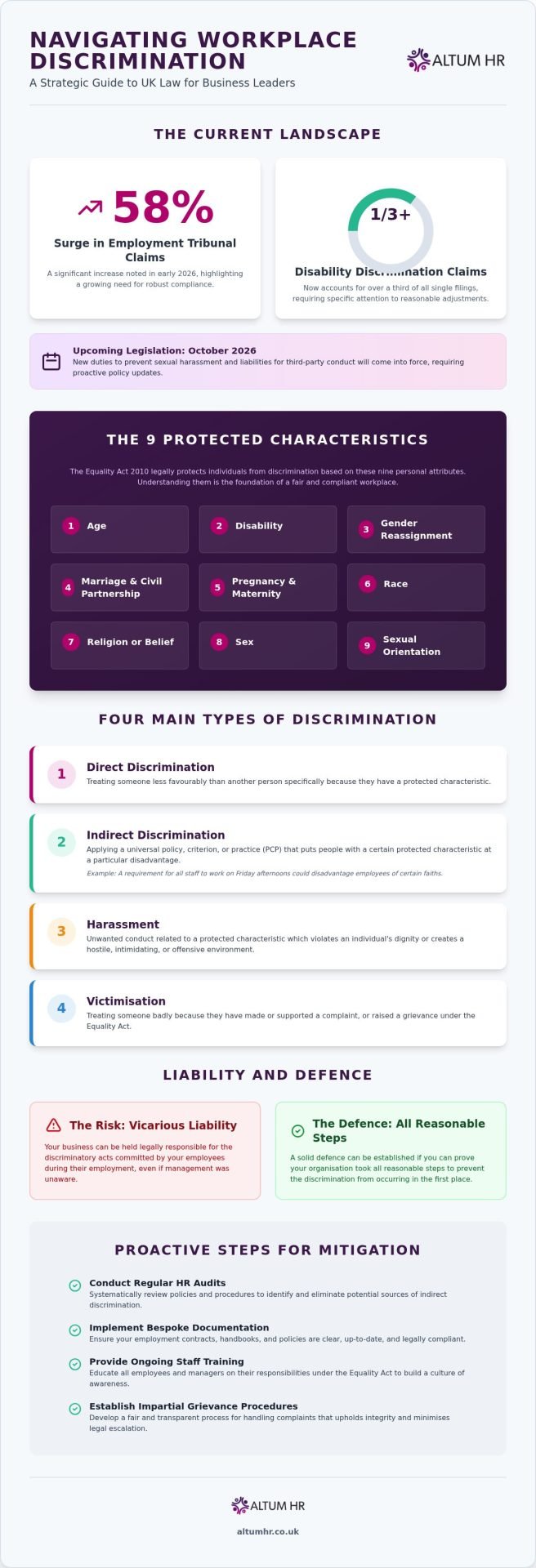
Did you know that employment tribunal claims surged by 58% in early 2026, with disability discrimination now accounting for over a third of all single filings? We recognise that keeping pace with discrimination in the workplace uk law can feel like chasing a moving target, particularly with the October 2026 introduction of heightened duties to prevent sexual harassment and new liabilities for third-party conduct. It’s natural for business leaders to feel a sense of unease regarding the complexities of vicarious liability or the subtle, often overlooked nuances of indirect discrimination.

We’re here to help you navigate these regulatory shifts with calm reliability. This guide provides the strategic clarity you need to move from a position of uncertainty to one of total security, ensuring your organisation is both legally compliant and culturally resilient. We’ll explore your core obligations under the Equality Act 2010, outline practical steps for risk mitigation, and provide the tools to manage sensitive grievances with expert confidence.

Key Takeaways

  • Gain a comprehensive understanding of discrimination in the workplace uk law to protect your organisation from costly tribunal claims and reputational damage.
  • Recognise the nine protected characteristics defined under the Equality Act 2010 to ensure your management decisions are consistently fair and lawful.
  • Identify the critical differences between direct and indirect discrimination, allowing you to evaluate whether existing policies inadvertently disadvantage specific groups.
  • Discover how proactive HR audits and bespoke employment documentation act as a vital catalyst for long-term stability and psychological security.
  • Learn the essential steps for conducting impartial grievance investigations that uphold professional integrity whilst effectively mitigating the risk of legal escalation.

Understanding the Equality Act 2010 and Protected Characteristics

The Equality Act 2010 serves as the cornerstone of UK employment equality law, consolidating various historical pieces of legislation into a single, cohesive framework. For business leaders, this act isn’t just a compliance checklist; it’s a blueprint for creating a secure, high-performing environment. At its heart, the law seeks to prevent individuals from being treated “less favourably” based on specific personal attributes. Understanding how this applies to discrimination in the workplace uk law is essential for any modern enterprise. Whilst direct discrimination usually requires a comparison with how another person is treated, pregnancy and maternity cases use the stricter test of “unfavourable treatment,” where no such comparison is needed to prove a breach.

The Nine Protected Characteristics: A Quick Reference

The Act identifies nine specific characteristics that receive legal protection. These include age, disability, gender reassignment, marriage and civil partnership, pregnancy and maternity, race, religion or belief, sex, and sexual orientation. Disability carries a specific legal definition: a physical or mental impairment that has a substantial and long-term adverse effect on an individual’s ability to carry out normal day-to-day activities. “Long-term” typically refers to an effect that has lasted, or is likely to last, at least 12 months. Protection for marriage and civil partnership is also unique, as it generally only applies to the workplace context, shielding employees from being treated poorly because they are married or in a civil partnership.

When Less Favourable Treatment is Lawful

There are rare, specific circumstances where treating someone differently isn’t unlawful. An “occupational requirement” allows an employer to specify a characteristic as a job necessity. For example, a domestic violence shelter for women may lawfully hire only female staff based on the nature of the service provided. Additionally, some forms of indirect discrimination can be defended through “objective justification.” We help leaders demonstrate that a particular policy is a “proportionate means of achieving a legitimate aim,” such as ensuring health and safety standards or meeting a genuine business need. It’s also vital to distinguish between positive action, which encourages underrepresented groups to apply, and positive discrimination, which remains unlawful in the UK. Ensuring your hr policies and contracts reflect these nuances provides a vital layer of organisational security.

Identifying the Four Main Types of Workplace Discrimination

Understanding the different ways discrimination manifests is the first step toward building a robust defence. Under discrimination in the workplace uk law, there are four primary categories that employers must recognise to maintain a secure environment. Direct discrimination is perhaps the most visible, occurring when an individual is treated less favourably than others specifically because of a protected characteristic. Harassment involves unwanted conduct that violates a person’s dignity or creates a hostile atmosphere. Finally, victimisation protects those who have raised a concern or assisted in an investigation, ensuring they aren’t punished for seeking justice. The Equality Act 2010 official guidance provides a detailed baseline for these definitions.

The Hidden Risk of Indirect Discrimination

Indirect discrimination is often more subtle and occurs when a Provision, Criterion, or Practice (PCP) is applied to everyone but disproportionately disadvantages a specific group. For instance, a requirement for all staff to work on Friday afternoons might seem neutral, yet it could indirectly discriminate against employees of certain faiths who attend religious services at that time. We recommend a thorough review of your company handbook to identify these accidental biases. If a policy cannot be objectively justified, it may leave your organisation vulnerable to claims.

Vicarious Liability: Why Employers are Responsible for Staff

A significant concern for leaders is vicarious liability. This legal principle means your business can be held responsible for the discriminatory acts of your employees, even if you were unaware of their behaviour at the time. However, you can establish a defence by proving you took all reasonable steps to prevent such conduct. This typically involves regular staff training and having clear, robust disciplinary procedures in place. By being proactive, you transform these administrative functions into a vital catalyst for long-term stability. If you’re concerned about your current exposure, our team can help you conduct a comprehensive audit of your HR policies to ensure total security.

Proactive Strategies to Mitigate Discrimination Risk

Proactive risk management is the most effective way to safeguard your organisation. Whilst many leaders focus on reactive measures, a thorough HR audit acts as a vital catalyst for long-term stability by identifying subtle cultural and policy gaps before they escalate. It’s about ensuring that every process, from initial hire to exit interview, is anchored in fairness. When we consider discrimination in the workplace uk law, the most resilient businesses are those that treat compliance as an ongoing strategic priority rather than a one-off administrative task. Uniform application of standards is essential for total security.

Objective selection criteria and “blind” recruitment processes help eliminate unconscious bias at the source. By removing names and identifying details from initial applications, you ensure that decisions are based solely on merit. This objectivity must extend throughout the employee lifecycle. For example, performance management must be applied consistently across all departments. Inconsistent appraisals or disciplinary actions are frequently cited in tribunal claims as evidence of bias. Ensuring your managers use data-driven, objective criteria protects the business and supports individual growth.

Developing Inclusive HR Policies and Contracts

Off-the-shelf templates often fail to provide the protection your business needs. They rarely account for the specific operational nuances of your industry, which can lead to accidental non-compliance with the Equality Act 2010 official guidance. Bespoke hr policies and contracts ensure that your Equal Opportunities and Anti-Harassment stances are clear, legally sound, and tailored to your workforce. These documents should be living entities. We recommend updating them regularly to reflect the latest legal precedents and organisational changes.

Effective Staff Training and Cultural Leadership

Regular diversity and inclusion training is a cornerstone of a robust legal defence. With the duty to prevent sexual harassment increasing to “all reasonable steps” on 30 October 2026, proactive education is more critical than ever. This isn’t just a tick-box exercise; it’s about fostering an environment where every individual feels psychologically secure. Senior leaders play a pivotal role here. By modelling professional behaviour whilst at work, executives set the standard for the entire organisation. Training should be interactive and scenario-based, ensuring that staff understand the collective responsibility to prevent harassment.

Book a bespoke HR audit to identify your compliance gaps
Discrimination in the Workplace: A UK Employer’s Guide to the Equality Act 2010

Handling Discrimination Grievances and Tribunal Risks

When a discrimination allegation lands on your desk, the immediate response determines the long-term outcome. It’s a high-stakes moment for any leader. To uphold the principles of discrimination in the workplace uk law, you must initiate a prompt and impartial investigation. Professional integrity is maintained by ensuring that the person investigating has no direct link to the incident. Procedural errors at this stage are the most common reason for losses at tribunal. Utilising outsourced HR support provides a vital shield against these mistakes, offering the objective distance required for a fair process.

The financial implications of a claim are significant. Unlike standard unfair dismissal, discrimination awards are uncapped, meaning the cost to your business can be substantial. In April 2026, the Vento bands for “injury to feelings” were updated, with the upper band now reaching up to £62,900 for the most serious cases. This is in addition to any awards for loss of earnings. With tribunal claims rising by 58% in early 2026, the risk of escalation is a genuine commercial threat that requires a methodical, expert-led response to ensure organisational security.

Managing Grievance Procedures Professionally

Adhering strictly to the Acas Code of Practice is non-negotiable. A fair hearing involves allowing the employee to state their case, providing them with the right to be accompanied, and offering an appeal process. Every conversation, email, and witness statement must be meticulously documented to defend against future legal claims. Clear grievance procedures act as a roadmap, ensuring that your organisation remains proactive and transparent throughout the dispute. Consistency here is the key to mitigating risk.

Employment Tribunal Defence: Protecting Your Reputation

If a claim progresses to an employment tribunal, the impact extends far beyond the financial cost. Publicly available judgments can cause lasting damage to your brand reputation and devastate staff morale. It’s often better to resolve issues internally through professional mediation or settlement before they reach this stage. For a broader look at the changing regulatory landscape, see our guide on UK Employment Law 2026: The Comprehensive Employer’s Guide to Compliance. We stand as a stabilising force for leaders facing these complex operational hurdles.

Securing Your Organisation’s Future Through Proactive Compliance

Mastering the intricacies of discrimination in the workplace uk law is about more than avoiding a tribunal; it’s a strategic investment in your company’s culture and long-term stability. By conducting thorough HR audits and implementing bespoke policies, you move beyond basic compliance to create a truly inclusive environment where psychological security is the standard. We’ve explored how impartial grievance investigations and robust disciplinary procedures act as a vital shield, protecting your brand’s reputation from the high costs and stress of legal claims.

As employer-side specialists, we’re here to help you navigate these complex regulatory waters with expert confidence. Our methodology ensures that your administrative functions become a catalyst for growth rather than a source of anxiety. We provide the calm reliability needed to handle day-to-day operational hurdles whilst maintaining an ethically grounded, modern outlook for your enterprise.

Protect your business with expert employment law advice from Altum HR

Let’s work together to ensure your organisation remains a secure, high-performing environment for every member of your team.

Frequently Asked Questions

What are the 9 protected characteristics under the Equality Act 2010?

The nine protected characteristics are age, disability, gender reassignment, marriage and civil partnership, pregnancy and maternity, race, religion or belief, sex, and sexual orientation. These attributes form the legal foundation of discrimination in the workplace uk law. You must ensure that no management decision, from recruitment to redundancy, is based on these factors. Providing a secure environment means recognising that these protections apply to employees, contractors, and even job applicants from their very first interaction with your business.

Can an employer be held responsible for an employee’s discriminatory behaviour?

Yes, through a principle called vicarious liability, you are generally responsible for discriminatory acts committed by your staff during their employment. To defend such a claim, you must prove you took “all reasonable steps” to prevent the behaviour. From 30 October 2026, this duty is specifically strengthened regarding the prevention of sexual harassment. We recommend regular training and robust policies to demonstrate that your organisation is proactive in maintaining a professional and respectful culture.

What is the difference between direct and indirect discrimination in the workplace?

Direct discrimination occurs when you treat an individual less favourably specifically because of a protected characteristic, such as refusing a promotion based on age. Indirect discrimination happens when a neutral policy or practice applies to everyone but disadvantages a specific group. For instance, requiring all staff to work on Saturdays might disadvantage certain religious groups. Unless you can prove this practice is a proportionate means of achieving a legitimate business aim, it remains unlawful.

How much can a discrimination claim cost a UK business in 2026?

Discrimination awards are uncapped, making them a significant financial risk. As of April 2026, “injury to feelings” awards follow the Vento bands: the lower band ranges from £1,300 to £12,600, whilst the upper band for the most serious cases reaches £62,900. When you include loss of earnings, potential legal fees, and the 58% rise in tribunal claims seen in early 2026, a single claim can easily exceed six figures. Total security is best achieved through professional grievance handling.

What are “reasonable adjustments” for disabled employees under UK law?

Reasonable adjustments are changes made to remove or reduce a disadvantage faced by a disabled employee. This duty arises if an impairment has a substantial, long-term effect on their ability to work. Practical examples include providing specialised ergonomic equipment, allowing flexible working hours, or modifying physical features of your office. The goal is to ensure the individual can perform their role effectively. Failing to make these adjustments is a frequent trigger for disability discrimination claims in the UK.

How can I prove that a policy is an “objective justification” for less favourable treatment?

To prove objective justification, you must show that your policy is a “proportionate means of achieving a legitimate aim.” A legitimate aim might include health and safety requirements or the genuine operational needs of the business. You must demonstrate that the business benefit outweighs the discriminatory impact on the employee and that no less discriminatory alternative was available. We help leaders document this reasoning clearly to provide a robust defence against potential indirect discrimination allegations.

Josephine Broadstock

Article by

Josephine Broadstock

Josephine Broadstock is the Founder of Altum HR and a recognised thought leader in HR strategy and operational delivery. With a career grounded in employment law and hands-on business support, Josie has built a reputation for helping organisations move beyond transactional HR into truly strategic, commercially aligned people management.

At the core of Josie’s approach is a belief that HR should not sit in isolation—it should actively drive business performance. She works closely with business owners and leadership teams to understand how their organisations function in practice, not just on paper, enabling the design and implementation of people strategies that are both legally robust and operationally effective.

Josie specialises in translating complex employment law and HR challenges into clear, practical solutions that support growth, reduce risk, and improve organisational efficiency. Her work often focuses on bridging the gap between policy and execution—ensuring that processes are not only compliant but also embedded into day-to-day operations in a way that adds measurable value.

Through Altum HR, Josephine leads a team of highly qualified consultants who share her commitment to quality, personalisation, and commercial impact. She is particularly passionate about raising standards within the HR industry, advocating for a more consultative, expert-led approach that prioritises long-term business outcomes over quick fixes.

As an author, Josie shares insights on employment law developments, operational best practice, and real-world HR challenges, offering business leaders practical guidance they can apply immediately. Her content is designed to cut through complexity and provide clarity in an ever-evolving workplace landscape.

Disclaimer

Disclaimer
The content on this blog is provided for general informational and educational purposes only and does not constitute professional advice. While we strive to ensure information is accurate and up to date, we make no warranties or representations about the completeness, accuracy, reliability, suitability, or availability of the information, products, services, or related graphics contained on the blog. Any reliance you place on such information is strictly at your own risk. We accept no liability for any loss or damage arising from the use of this blog or reliance on its content.
No Professional Relationship
Use of this blog does not create a professional client relationship between you and Altum HR. For personalised advice, please consult a qualified professional in the relevant field.
Third‑Party Links and Content
This blog may contain links to third‑party websites, products, or services. Links are provided for convenience only and do not imply endorsement. We are not responsible for the content, privacy practices, or accuracy of third‑party sites and accept no liability for any loss or damage arising from their use.
Affiliate and Sponsored Content
Where applicable, we may receive compensation for products or services mentioned. We only recommend products we believe in, but you should perform your own due diligence before purchasing.
Intellectual Property
All content on this blog is protected by copyright unless otherwise stated. You may not reproduce, distribute, or create derivative works from our content without prior written permission.
Governing Law
This disclaimer and any dispute arising out of or in connection with the blog are governed by the laws of England and Wales.


Did you know that employment tribunal claims surged by 58% in early 2026, with disability discrimination now accounting for over a third of all single filings? We recognise that keeping pace with discrimination in the workplace uk law can feel like chasing a moving target, particularly with the October 2026 introduction of heightened duties to prevent sexual harassment and new liabilities for third-party conduct. It’s natural for business leaders to feel a sense of unease regarding the complexities of vicarious liability or the subtle, often overlooked nuances of indirect discrimination.

We’re here to help you navigate these regulatory shifts with calm reliability. This guide provides the strategic clarity you need to move from a position of uncertainty to one of total security, ensuring your organisation is both legally compliant and culturally resilient. We’ll explore your core obligations under the Equality Act 2010, outline practical steps for risk mitigation, and provide the tools to manage sensitive grievances with expert confidence.

Key Takeaways

  • Gain a comprehensive understanding of discrimination in the workplace uk law to protect your organisation from costly tribunal claims and reputational damage.
  • Recognise the nine protected characteristics defined under the Equality Act 2010 to ensure your management decisions are consistently fair and lawful.
  • Identify the critical differences between direct and indirect discrimination, allowing you to evaluate whether existing policies inadvertently disadvantage specific groups.
  • Discover how proactive HR audits and bespoke employment documentation act as a vital catalyst for long-term stability and psychological security.
  • Learn the essential steps for conducting impartial grievance investigations that uphold professional integrity whilst effectively mitigating the risk of legal escalation.

Understanding the Equality Act 2010 and Protected Characteristics

The Equality Act 2010 serves as the cornerstone of UK employment equality law, consolidating various historical pieces of legislation into a single, cohesive framework. For business leaders, this act isn’t just a compliance checklist; it’s a blueprint for creating a secure, high-performing environment. At its heart, the law seeks to prevent individuals from being treated “less favourably” based on specific personal attributes. Understanding how this applies to discrimination in the workplace uk law is essential for any modern enterprise. Whilst direct discrimination usually requires a comparison with how another person is treated, pregnancy and maternity cases use the stricter test of “unfavourable treatment,” where no such comparison is needed to prove a breach.

The Nine Protected Characteristics: A Quick Reference

The Act identifies nine specific characteristics that receive legal protection. These include age, disability, gender reassignment, marriage and civil partnership, pregnancy and maternity, race, religion or belief, sex, and sexual orientation. Disability carries a specific legal definition: a physical or mental impairment that has a substantial and long-term adverse effect on an individual’s ability to carry out normal day-to-day activities. “Long-term” typically refers to an effect that has lasted, or is likely to last, at least 12 months. Protection for marriage and civil partnership is also unique, as it generally only applies to the workplace context, shielding employees from being treated poorly because they are married or in a civil partnership.

When Less Favourable Treatment is Lawful

There are rare, specific circumstances where treating someone differently isn’t unlawful. An “occupational requirement” allows an employer to specify a characteristic as a job necessity. For example, a domestic violence shelter for women may lawfully hire only female staff based on the nature of the service provided. Additionally, some forms of indirect discrimination can be defended through “objective justification.” We help leaders demonstrate that a particular policy is a “proportionate means of achieving a legitimate aim,” such as ensuring health and safety standards or meeting a genuine business need. It’s also vital to distinguish between positive action, which encourages underrepresented groups to apply, and positive discrimination, which remains unlawful in the UK. Ensuring your hr policies and contracts reflect these nuances provides a vital layer of organisational security.

Identifying the Four Main Types of Workplace Discrimination

Understanding the different ways discrimination manifests is the first step toward building a robust defence. Under discrimination in the workplace uk law, there are four primary categories that employers must recognise to maintain a secure environment. Direct discrimination is perhaps the most visible, occurring when an individual is treated less favourably than others specifically because of a protected characteristic. Harassment involves unwanted conduct that violates a person’s dignity or creates a hostile atmosphere. Finally, victimisation protects those who have raised a concern or assisted in an investigation, ensuring they aren’t punished for seeking justice. The Equality Act 2010 official guidance provides a detailed baseline for these definitions.

The Hidden Risk of Indirect Discrimination

Indirect discrimination is often more subtle and occurs when a Provision, Criterion, or Practice (PCP) is applied to everyone but disproportionately disadvantages a specific group. For instance, a requirement for all staff to work on Friday afternoons might seem neutral, yet it could indirectly discriminate against employees of certain faiths who attend religious services at that time. We recommend a thorough review of your company handbook to identify these accidental biases. If a policy cannot be objectively justified, it may leave your organisation vulnerable to claims.

Vicarious Liability: Why Employers are Responsible for Staff

A significant concern for leaders is vicarious liability. This legal principle means your business can be held responsible for the discriminatory acts of your employees, even if you were unaware of their behaviour at the time. However, you can establish a defence by proving you took all reasonable steps to prevent such conduct. This typically involves regular staff training and having clear, robust disciplinary procedures in place. By being proactive, you transform these administrative functions into a vital catalyst for long-term stability. If you’re concerned about your current exposure, our team can help you conduct a comprehensive audit of your HR policies to ensure total security.

Proactive Strategies to Mitigate Discrimination Risk

Proactive risk management is the most effective way to safeguard your organisation. Whilst many leaders focus on reactive measures, a thorough HR audit acts as a vital catalyst for long-term stability by identifying subtle cultural and policy gaps before they escalate. It’s about ensuring that every process, from initial hire to exit interview, is anchored in fairness. When we consider discrimination in the workplace uk law, the most resilient businesses are those that treat compliance as an ongoing strategic priority rather than a one-off administrative task. Uniform application of standards is essential for total security.

Objective selection criteria and “blind” recruitment processes help eliminate unconscious bias at the source. By removing names and identifying details from initial applications, you ensure that decisions are based solely on merit. This objectivity must extend throughout the employee lifecycle. For example, performance management must be applied consistently across all departments. Inconsistent appraisals or disciplinary actions are frequently cited in tribunal claims as evidence of bias. Ensuring your managers use data-driven, objective criteria protects the business and supports individual growth.

Developing Inclusive HR Policies and Contracts

Off-the-shelf templates often fail to provide the protection your business needs. They rarely account for the specific operational nuances of your industry, which can lead to accidental non-compliance with the Equality Act 2010 official guidance. Bespoke hr policies and contracts ensure that your Equal Opportunities and Anti-Harassment stances are clear, legally sound, and tailored to your workforce. These documents should be living entities. We recommend updating them regularly to reflect the latest legal precedents and organisational changes.

Effective Staff Training and Cultural Leadership

Regular diversity and inclusion training is a cornerstone of a robust legal defence. With the duty to prevent sexual harassment increasing to “all reasonable steps” on 30 October 2026, proactive education is more critical than ever. This isn’t just a tick-box exercise; it’s about fostering an environment where every individual feels psychologically secure. Senior leaders play a pivotal role here. By modelling professional behaviour whilst at work, executives set the standard for the entire organisation. Training should be interactive and scenario-based, ensuring that staff understand the collective responsibility to prevent harassment.

Book a bespoke HR audit to identify your compliance gaps

Handling Discrimination Grievances and Tribunal Risks

When a discrimination allegation lands on your desk, the immediate response determines the long-term outcome. It’s a high-stakes moment for any leader. To uphold the principles of discrimination in the workplace uk law, you must initiate a prompt and impartial investigation. Professional integrity is maintained by ensuring that the person investigating has no direct link to the incident. Procedural errors at this stage are the most common reason for losses at tribunal. Utilising outsourced HR support provides a vital shield against these mistakes, offering the objective distance required for a fair process.

The financial implications of a claim are significant. Unlike standard unfair dismissal, discrimination awards are uncapped, meaning the cost to your business can be substantial. In April 2026, the Vento bands for “injury to feelings” were updated, with the upper band now reaching up to £62,900 for the most serious cases. This is in addition to any awards for loss of earnings. With tribunal claims rising by 58% in early 2026, the risk of escalation is a genuine commercial threat that requires a methodical, expert-led response to ensure organisational security.

Managing Grievance Procedures Professionally

Adhering strictly to the Acas Code of Practice is non-negotiable. A fair hearing involves allowing the employee to state their case, providing them with the right to be accompanied, and offering an appeal process. Every conversation, email, and witness statement must be meticulously documented to defend against future legal claims. Clear grievance procedures act as a roadmap, ensuring that your organisation remains proactive and transparent throughout the dispute. Consistency here is the key to mitigating risk.

Employment Tribunal Defence: Protecting Your Reputation

If a claim progresses to an employment tribunal, the impact extends far beyond the financial cost. Publicly available judgments can cause lasting damage to your brand reputation and devastate staff morale. It’s often better to resolve issues internally through professional mediation or settlement before they reach this stage. For a broader look at the changing regulatory landscape, see our guide on UK Employment Law 2026: The Comprehensive Employer’s Guide to Compliance. We stand as a stabilising force for leaders facing these complex operational hurdles.

Securing Your Organisation’s Future Through Proactive Compliance

Mastering the intricacies of discrimination in the workplace uk law is about more than avoiding a tribunal; it’s a strategic investment in your company’s culture and long-term stability. By conducting thorough HR audits and implementing bespoke policies, you move beyond basic compliance to create a truly inclusive environment where psychological security is the standard. We’ve explored how impartial grievance investigations and robust disciplinary procedures act as a vital shield, protecting your brand’s reputation from the high costs and stress of legal claims.

As employer-side specialists, we’re here to help you navigate these complex regulatory waters with expert confidence. Our methodology ensures that your administrative functions become a catalyst for growth rather than a source of anxiety. We provide the calm reliability needed to handle day-to-day operational hurdles whilst maintaining an ethically grounded, modern outlook for your enterprise.

Protect your business with expert employment law advice from Altum HR

Let’s work together to ensure your organisation remains a secure, high-performing environment for every member of your team.

Frequently Asked Questions

What are the 9 protected characteristics under the Equality Act 2010?

The nine protected characteristics are age, disability, gender reassignment, marriage and civil partnership, pregnancy and maternity, race, religion or belief, sex, and sexual orientation. These attributes form the legal foundation of discrimination in the workplace uk law. You must ensure that no management decision, from recruitment to redundancy, is based on these factors. Providing a secure environment means recognising that these protections apply to employees, contractors, and even job applicants from their very first interaction with your business.

Can an employer be held responsible for an employee’s discriminatory behaviour?

Yes, through a principle called vicarious liability, you are generally responsible for discriminatory acts committed by your staff during their employment. To defend such a claim, you must prove you took “all reasonable steps” to prevent the behaviour. From 30 October 2026, this duty is specifically strengthened regarding the prevention of sexual harassment. We recommend regular training and robust policies to demonstrate that your organisation is proactive in maintaining a professional and respectful culture.

What is the difference between direct and indirect discrimination in the workplace?

Direct discrimination occurs when you treat an individual less favourably specifically because of a protected characteristic, such as refusing a promotion based on age. Indirect discrimination happens when a neutral policy or practice applies to everyone but disadvantages a specific group. For instance, requiring all staff to work on Saturdays might disadvantage certain religious groups. Unless you can prove this practice is a proportionate means of achieving a legitimate business aim, it remains unlawful.

How much can a discrimination claim cost a UK business in 2026?

Discrimination awards are uncapped, making them a significant financial risk. As of April 2026, “injury to feelings” awards follow the Vento bands: the lower band ranges from £1,300 to £12,600, whilst the upper band for the most serious cases reaches £62,900. When you include loss of earnings, potential legal fees, and the 58% rise in tribunal claims seen in early 2026, a single claim can easily exceed six figures. Total security is best achieved through professional grievance handling.

What are “reasonable adjustments” for disabled employees under UK law?

Reasonable adjustments are changes made to remove or reduce a disadvantage faced by a disabled employee. This duty arises if an impairment has a substantial, long-term effect on their ability to work. Practical examples include providing specialised ergonomic equipment, allowing flexible working hours, or modifying physical features of your office. The goal is to ensure the individual can perform their role effectively. Failing to make these adjustments is a frequent trigger for disability discrimination claims in the UK.

How can I prove that a policy is an “objective justification” for less favourable treatment?

To prove objective justification, you must show that your policy is a “proportionate means of achieving a legitimate aim.” A legitimate aim might include health and safety requirements or the genuine operational needs of the business. You must demonstrate that the business benefit outweighs the discriminatory impact on the employee and that no less discriminatory alternative was available. We help leaders document this reasoning clearly to provide a robust defence against potential indirect discrimination allegations.

Josephine Broadstock

Article by

Josephine Broadstock

Josephine Broadstock is the Founder of Altum HR and a recognised thought leader in HR strategy and operational delivery. With a career grounded in employment law and hands-on business support, Josie has built a reputation for helping organisations move beyond transactional HR into truly strategic, commercially aligned people management.

At the core of Josie’s approach is a belief that HR should not sit in isolation—it should actively drive business performance. She works closely with business owners and leadership teams to understand how their organisations function in practice, not just on paper, enabling the design and implementation of people strategies that are both legally robust and operationally effective.

Josie specialises in translating complex employment law and HR challenges into clear, practical solutions that support growth, reduce risk, and improve organisational efficiency. Her work often focuses on bridging the gap between policy and execution—ensuring that processes are not only compliant but also embedded into day-to-day operations in a way that adds measurable value.

Through Altum HR, Josephine leads a team of highly qualified consultants who share her commitment to quality, personalisation, and commercial impact. She is particularly passionate about raising standards within the HR industry, advocating for a more consultative, expert-led approach that prioritises long-term business outcomes over quick fixes.

As an author, Josie shares insights on employment law developments, operational best practice, and real-world HR challenges, offering business leaders practical guidance they can apply immediately. Her content is designed to cut through complexity and provide clarity in an ever-evolving workplace landscape.

Disclaimer

Disclaimer
The content on this blog is provided for general informational and educational purposes only and does not constitute professional advice. While we strive to ensure information is accurate and up to date, we make no warranties or representations about the completeness, accuracy, reliability, suitability, or availability of the information, products, services, or related graphics contained on the blog. Any reliance you place on such information is strictly at your own risk. We accept no liability for any loss or damage arising from the use of this blog or reliance on its content.
No Professional Relationship
Use of this blog does not create a professional client relationship between you and Altum HR. For personalised advice, please consult a qualified professional in the relevant field.
Third‑Party Links and Content
This blog may contain links to third‑party websites, products, or services. Links are provided for convenience only and do not imply endorsement. We are not responsible for the content, privacy practices, or accuracy of third‑party sites and accept no liability for any loss or damage arising from their use.
Affiliate and Sponsored Content
Where applicable, we may receive compensation for products or services mentioned. We only recommend products we believe in, but you should perform your own due diligence before purchasing.
Intellectual Property
All content on this blog is protected by copyright unless otherwise stated. You may not reproduce, distribute, or create derivative works from our content without prior written permission.
Governing Law
This disclaimer and any dispute arising out of or in connection with the blog are governed by the laws of England and Wales.

Call now for instant HR advice on 0800 048 5764 or WhatsApp 07432 275612.

Discrimination in the Workplace: A UK Employer’s Guide to the Equality Act 2010

Book an HR Consultation

From HR advice, policies to Employment Law, Redundancy Support and Employee Contracts - we can help. Leave your details below and we'll be in touch.


Your data will be processed inline with our privacy policy. We respect your right to privacy and continuously strive to ensure that all data that we collect and store is done so securely and is properly protected.