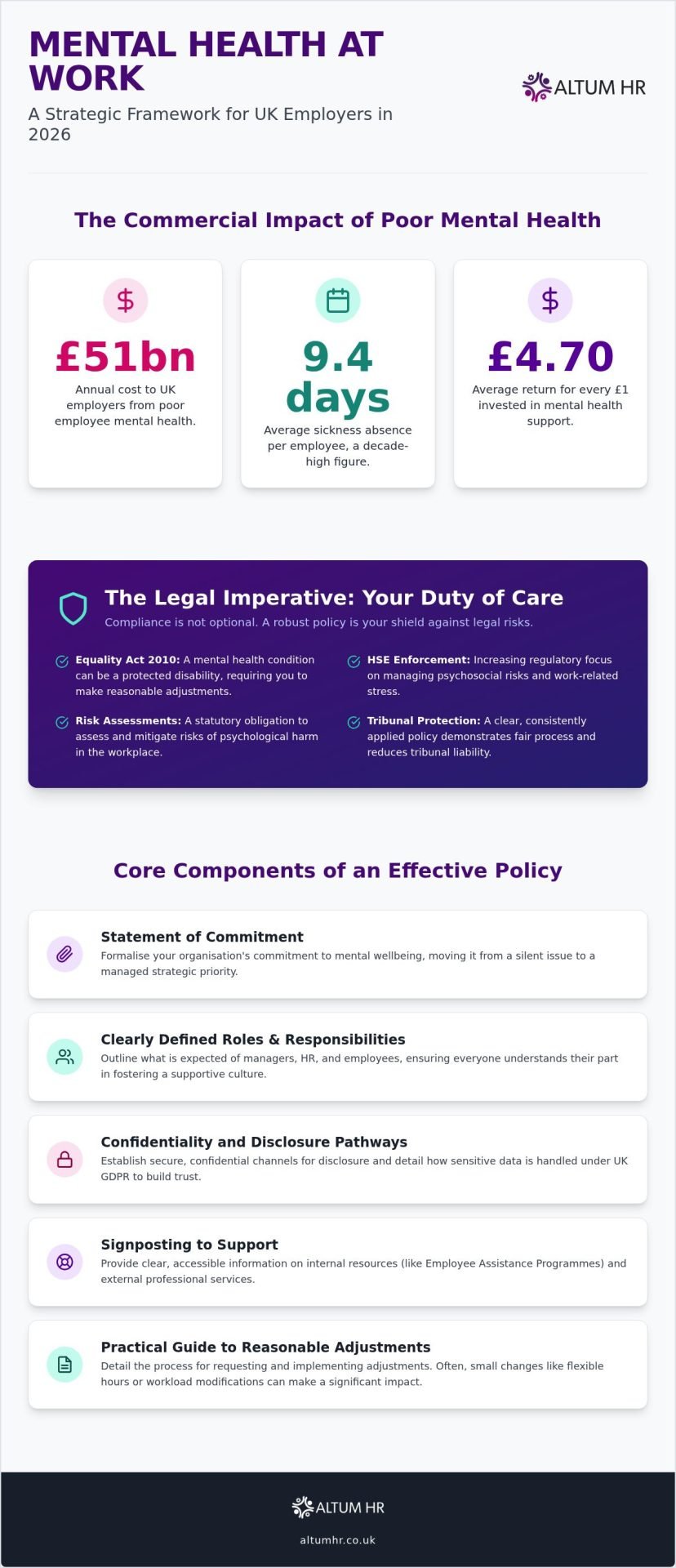
Did you know that poor mental health is now costing UK employers an estimated £51 billion every year? With sickness absence rates reaching a decade-high of 9.4 days per employee in 2025, establishing a clear mental health at work policy uk is now a commercial necessity rather than an optional extra. We recognise the pressure this puts on leaders who are often caught between rising absence figures and the fear of potential employment tribunals. It’s a complex landscape, especially when you’re trying to determine what actually constitutes a “reasonable adjustment” under the Equality Act 2010.
In this 2026 guide, we’ll show you how to develop a robust framework that protects your business whilst fostering a culture of genuine support. You’ll learn how to navigate the latest HSE enforcement focus on psychosocial risks and implement strategies that reduce legal liability and improve staff engagement. We’ll break down the essential components of a modern policy, from manager training to strategic wellbeing, ensuring your approach is both legally compliant and human-centred. By the end of this article, you’ll have a clear roadmap for transforming your duty of care into a strategic advantage.
Key Takeaways
Understand the shifting regulatory landscape and how the HSE’s 2026 focus on psychosocial risks impacts your legal duty of care.
Learn how to draft a comprehensive mental health at work policy uk that clearly defines roles and responsibilities for both managers and staff.
Discover the methodology for conducting effective workplace stress risk assessments to identify and mitigate organisational triggers.
Identify the specific training requirements your line managers need to handle mental health disclosures and reasonable adjustment requests professionally.
Find out how tailored HR consultancy can transform your wellbeing strategy from a compliance tick-box into a catalyst for long-term stability.
Why a Mental Health at Work Policy is Essential in 2026
Managing workplace wellbeing has evolved from a peripheral HR task into a core strategic priority. By 2026, the financial implications of ignoring staff welfare have become impossible to ignore. Deloitte’s 2024 research highlights that poor mental health costs UK employers approximately £51 billion annually. While sickness absence is the most visible cost, presenteeism, where employees are physically present but mentally disengaged, accounts for nearly half of that total. Relying on superficial “wellbeing perks” like office yoga or fruit baskets is no longer sufficient. Leaders need a structured, professional mental health at work policy uk to manage these complex risks effectively.
A formalised policy acts as a shield for your organisation. It moves beyond reactive measures, creating a proactive framework that reduces the likelihood of costly employment tribunals. By clearly outlining support mechanisms, you demonstrate that your business takes its duty of care seriously. This clarity is vital for maintaining a healthy, stable workforce and protecting your commercial reputation.
The Legal Framework: Equality Act 2010 and Beyond
The legal environment for employers is increasingly stringent. Under the Equality Act 2010, a mental health condition is classified as a protected disability if it has a “substantial and long-term adverse effect” on an individual’s ability to perform daily tasks. Failing to recognise this can lead to discrimination claims and significant financial penalties. Employers have a statutory obligation to conduct risk assessments for work-related stress and implement reasonable adjustments to protect their staff from psychological harm. With the HSE increasing enforcement regarding psychosocial risks, having a robust mental health at work policy uk ensures you remain on the right side of the law.
The Business Case for Mental Wellbeing
Investing in psychological security isn’t just about compliance; it’s about commercial agility. Organisations that prioritise Occupational health psychology principles often see a significant return on investment, with Deloitte reporting an average return of £4.70 for every £1 spent on support. A clear policy improves employee retention and makes your business more attractive to top talent who value a supportive culture. To understand how this fits into your broader regulatory requirements, you can explore our guide on UK Employment Law 2026. Ultimately, a healthy workforce is a resilient one, capable of navigating the pressures of modern industry with confidence.
What Should Your Mental Health at Work Policy Include?
A well-crafted mental health at work policy uk serves as a definitive guide for your entire organisation. It starts with a clear statement of commitment, moving mental health from a “silent” issue to an open, managed part of your business strategy. We recommend clearly defining roles; whilst managers aren’t expected to be medical experts, they must be trained to recognise when a colleague might be struggling. Employees, in turn, should understand the safe, confidential pathways available for disclosure. This transparency builds the psychological security necessary for a high-performing team.
Crucially, your policy shouldn’t exist in isolation. It must be seamlessly integrated with your existing disciplinary procedures. If an employee’s performance or conduct is impacted by their mental health, your framework should dictate a supportive rather than punitive initial response. This integrated approach ensures you’re protecting the individual whilst maintaining organisational standards. Employers have a legal responsibility to help their employees by identifying risks and providing support before issues escalate into long-term absence or legal disputes.
Core Components of a Bespoke Policy
Confidentiality is the cornerstone of trust. Your policy must outline how sensitive data is handled under UK GDPR, ensuring employees feel secure when sharing personal challenges. Effective policies also include clear signposting to internal resources, such as Employee Assistance Programmes (EAPs), and external support services. Furthermore, you should establish specific protocols for managing absence related to mental health, focusing on phased returns and ongoing support rather than just monitoring “lost hours”.
Reasonable Adjustments: A Practical Guide
Adjustments don’t always require significant financial investment. Often, small changes make the biggest impact on an employee’s ability to remain productive. Consider these practical examples:
Flexible working: Adjusting start and finish times to accommodate therapy or medication side effects.
Altered duties: Temporarily reallocating high-stress tasks during difficult periods.
Environment changes: Providing a quieter workspace or noise-cancelling headphones to reduce sensory overload.
It’s vital to document these decisions thoroughly. Keeping a formal record of why an adjustment was made and setting dates for regular reviews protects both parties and ensures the support remains effective as the situation evolves. If you’re looking to modernise your documentation, our team can assist with bespoke policy creation tailored to your specific industry needs.
Implementing the Policy: From Paper to Practice
Turning a written document into a living culture requires more than just a signature at the bottom of a page. To truly embed your mental health at work policy uk, you must start with a robust risk assessment. The HSE Management Standards provide a structured approach to identifying organisational stressors across six key areas: demands, control, support, relationships, role, and change. By systematically evaluating these factors, you can pinpoint where your team feels the most pressure before it leads to burnout. Whilst the HSE provides the framework, many businesses find that working with a consultant helps to translate these high-level requirements into actionable steps.
Effective implementation also relies on visibility. We recommend using employee management software to track absence patterns and identify emerging trends. If you notice a spike in short-term sickness in a specific department, it’s often an early warning sign that the policy isn’t being applied consistently. Coupling data with regular “check-ins” ensures that communication remains a two-way street, allowing staff to voice concerns before they escalate into long-term issues.
Line managers are the frontline of your strategy. They need the confidence to handle a mental health disclosure with sensitivity whilst maintaining the standards required for effective performance management. It’s a delicate balance. We provide leaders with the specific conversational tools they need to support an individual without compromising team output. Resources like Mental Health at Work offer excellent supplementary guidance, but bespoke training ensures your managers know exactly how your internal procedures function in real-time.
Evaluating the Effectiveness of Your Policy
A policy is only as good as the results it delivers. We suggest using anonymous staff surveys to gauge how safe employees feel when discussing their wellbeing. Reviewing sickness data alongside this qualitative feedback helps you identify “hot spots” where stress may be concentrated. A professional HR audit can identify gaps in policy implementation, ensuring your procedures are actually being followed across every level of the organisation. This objective review prevents your policy from becoming a static document and ensures it remains a vital catalyst for long-term stability.
How Altum HR Supports Your Mental Health Strategy
Developing a comprehensive mental health at work policy uk is a significant undertaking that requires both legal precision and cultural sensitivity. At Altum HR, we provide the expert guidance needed to transform these complex requirements into a functional business asset. Our team specialises in creating bespoke policies that reflect your specific industry challenges rather than relying on restrictive, generic templates. We also provide the high-level employment law advice necessary to navigate intricate disability claims, ensuring you’re protected from the risks of discrimination as defined by the Equality Act 2010.
We bridge the gap between policy and practice by integrating your wellbeing strategy with our bespoke employee management software. This allows you to monitor absence trends in real-time and trigger supportive interventions at the earliest possible stage. By combining data-driven insights with human-centric expertise, we help you manage long-term sickness and phased return-to-work programmes with total confidence. This thoroughness ensures that your administrative functions act as a vital catalyst for growth rather than a bureaucratic burden.
Proactive Protection for UK Employers
Our outsourced HR services act as a stabilising force for leaders who find themselves overwhelmed by personnel management. We understand that mental health crises don’t always happen during standard office hours. Having an expert on hand to provide 24/7 employment law advice ensures you can handle sensitive disclosures or urgent grievances with immediate professional support. This constant availability alleviates the anxiety often associated with regulatory compliance and allows you to focus on your core operations with absolute security.
Whilst generic templates might offer a surface-level fix, they often fail to stand up under the scrutiny of an employment tribunal. Our bespoke solutions are designed to address the root causes of organisational friction, providing a much stronger legal defence if a claim arises. We’re committed to an ethically grounded approach that prioritises the individual within your organisation, fostering a culture where staff feel genuinely valued. Getting started is a straightforward process of collaboration. We’ll work alongside you to audit your current procedures and build a resilient framework that ensures your business remains a healthy, productive, and compliant place to work.
Future-Proofing Your Organisation Through Psychological Security
Implementing a robust mental health at work policy uk is no longer just a defensive legal measure; it’s a strategic investment in your people. We’ve explored how a tailored framework reduces sickness absence and protects your business from the escalating risks of employment tribunals. By moving beyond generic templates and embracing bespoke, human-centric support, you create a culture where employees feel safe to perform at their best. This approach ensures your administrative functions act as a vital catalyst for growth rather than a bureaucratic burden.
Our national UK coverage ensures that your organisation has access to expert employment law advice whenever a complex personnel issue arises. We provide the professional support needed to navigate the Equality Act 2010 whilst keeping your commercial objectives firmly in sight. This collaborative partnership allows you to manage mental health with both technical precision and empathy, providing a stabilising force for your leadership team.
Taking the first step towards a healthier workplace doesn’t have to be daunting. With the right guidance, you can transform your approach to wellbeing into a powerful tool for long-term stability and organisational success.
Frequently Asked Questions
Is a mental health at work policy a legal requirement in the UK?
While there isn’t a specific law stating you must have a standalone policy, it’s practically essential for meeting your statutory duties. The Health and Safety at Work Act 1974 and the Management of Health and Safety at Work Regulations 1999 require you to assess and manage risks to employee health, including mental wellbeing. Having a formal mental health at work policy uk provides the structured evidence needed to prove you’re fulfilling your legal duty of care.
What are “reasonable adjustments” for mental health conditions?
Reasonable adjustments are practical changes made to a job or the workplace to help an employee manage their mental health. These might include flexible start times to avoid rush-hour anxiety, providing a quiet area for focused tasks, or adjusting workload during difficult periods. The goal is to remove barriers that prevent the individual from performing their role effectively. You should always document the consultation process and review the effectiveness of these adjustments regularly.
Can an employee be dismissed for mental health reasons?
Dismissing an employee due to mental ill-health is a high-risk area that requires careful management. You can only consider dismissal on the grounds of “capability” after you’ve explored all reasonable adjustments and sought medical evidence. If the individual remains unable to perform their core duties despite your support, a fair dismissal process may be possible. We strongly recommend seeking expert employment law advice before taking this step to avoid costly discrimination or unfair dismissal claims.
How does the Equality Act 2010 protect employees with mental health issues?
The Act protects employees if their mental health condition has a “substantial and long-term” effect on their ability to carry out normal day-to-day activities. This legal status prevents you from treating them less favourably because of their condition. It also places a proactive duty on you to make adjustments that support their continued employment. Consistently applying your mental health at work policy uk ensures your organisation remains compliant with these complex disability discrimination laws.
What is the difference between work-related stress and a mental health condition?
Work-related stress is often a reaction to excessive pressure or demands, whereas a mental health condition is a diagnosable medical state like depression. Stress isn’t a medical condition in itself, but prolonged exposure can trigger or worsen serious clinical issues. You have a legal responsibility to conduct risk assessments for stress under health and safety law, whilst diagnosable conditions often trigger additional protections and adjustment requirements under the Equality Act 2010.
How should a manager handle a disclosure of mental ill-health?
Managers should respond with empathy, maintain strict confidentiality, and focus on practical support rather than medical diagnosis. The first step is to have a private conversation to understand how the condition affects the employee’s work. You don’t need to be a mental health professional to offer help. Simply following your internal procedures and signposting the individual to an Employee Assistance Programme (EAP) or their GP ensures the disclosure is handled with total security.
Article by
Josephine Broadstock
Josephine Broadstock is the Founder of Altum HR and a recognised thought leader in HR strategy and operational delivery. With a career grounded in employment law and hands-on business support, Josie has built a reputation for helping organisations move beyond transactional HR into truly strategic, commercially aligned people management.
At the core of Josie’s approach is a belief that HR should not sit in isolation—it should actively drive business performance. She works closely with business owners and leadership teams to understand how their organisations function in practice, not just on paper, enabling the design and implementation of people strategies that are both legally robust and operationally effective.
Josie specialises in translating complex employment law and HR challenges into clear, practical solutions that support growth, reduce risk, and improve organisational efficiency. Her work often focuses on bridging the gap between policy and execution—ensuring that processes are not only compliant but also embedded into day-to-day operations in a way that adds measurable value.
Through Altum HR, Josephine leads a team of highly qualified consultants who share her commitment to quality, personalisation, and commercial impact. She is particularly passionate about raising standards within the HR industry, advocating for a more consultative, expert-led approach that prioritises long-term business outcomes over quick fixes.
As an author, Josie shares insights on employment law developments, operational best practice, and real-world HR challenges, offering business leaders practical guidance they can apply immediately. Her content is designed to cut through complexity and provide clarity in an ever-evolving workplace landscape.
Disclaimer
Disclaimer The content on this blog is provided for general informational and educational purposes only and does not constitute professional advice. While we strive to ensure information is accurate and up to date, we make no warranties or representations about the completeness, accuracy, reliability, suitability, or availability of the information, products, services, or related graphics contained on the blog. Any reliance you place on such information is strictly at your own risk. We accept no liability for any loss or damage arising from the use of this blog or reliance on its content. No Professional Relationship Use of this blog does not create a professional client relationship between you and Altum HR. For personalised advice, please consult a qualified professional in the relevant field. Third‑Party Links and Content This blog may contain links to third‑party websites, products, or services. Links are provided for convenience only and do not imply endorsement. We are not responsible for the content, privacy practices, or accuracy of third‑party sites and accept no liability for any loss or damage arising from their use. Affiliate and Sponsored Content Where applicable, we may receive compensation for products or services mentioned. We only recommend products we believe in, but you should perform your own due diligence before purchasing. Intellectual Property All content on this blog is protected by copyright unless otherwise stated. You may not reproduce, distribute, or create derivative works from our content without prior written permission. Governing Law This disclaimer and any dispute arising out of or in connection with the blog are governed by the laws of England and Wales.

Did you know that poor mental health is now costing UK employers an estimated £51 billion every year? With sickness absence rates reaching a decade-high of 9.4 days per employee in 2025, establishing a clear mental health at work policy uk is now a commercial necessity rather than an optional extra. We recognise the pressure this puts on leaders who are often caught between rising absence figures and the fear of potential employment tribunals. It’s a complex landscape, especially when you’re trying to determine what actually constitutes a “reasonable adjustment” under the Equality Act 2010.
In this 2026 guide, we’ll show you how to develop a robust framework that protects your business whilst fostering a culture of genuine support. You’ll learn how to navigate the latest HSE enforcement focus on psychosocial risks and implement strategies that reduce legal liability and improve staff engagement. We’ll break down the essential components of a modern policy, from manager training to strategic wellbeing, ensuring your approach is both legally compliant and human-centred. By the end of this article, you’ll have a clear roadmap for transforming your duty of care into a strategic advantage.
Key Takeaways
Understand the shifting regulatory landscape and how the HSE’s 2026 focus on psychosocial risks impacts your legal duty of care.
Learn how to draft a comprehensive mental health at work policy uk that clearly defines roles and responsibilities for both managers and staff.
Discover the methodology for conducting effective workplace stress risk assessments to identify and mitigate organisational triggers.
Identify the specific training requirements your line managers need to handle mental health disclosures and reasonable adjustment requests professionally.
Find out how tailored HR consultancy can transform your wellbeing strategy from a compliance tick-box into a catalyst for long-term stability.
Why a Mental Health at Work Policy is Essential in 2026
Managing workplace wellbeing has evolved from a peripheral HR task into a core strategic priority. By 2026, the financial implications of ignoring staff welfare have become impossible to ignore. Deloitte’s 2024 research highlights that poor mental health costs UK employers approximately £51 billion annually. While sickness absence is the most visible cost, presenteeism, where employees are physically present but mentally disengaged, accounts for nearly half of that total. Relying on superficial “wellbeing perks” like office yoga or fruit baskets is no longer sufficient. Leaders need a structured, professional mental health at work policy uk to manage these complex risks effectively.
A formalised policy acts as a shield for your organisation. It moves beyond reactive measures, creating a proactive framework that reduces the likelihood of costly employment tribunals. By clearly outlining support mechanisms, you demonstrate that your business takes its duty of care seriously. This clarity is vital for maintaining a healthy, stable workforce and protecting your commercial reputation.
The Legal Framework: Equality Act 2010 and Beyond
The legal environment for employers is increasingly stringent. Under the Equality Act 2010, a mental health condition is classified as a protected disability if it has a “substantial and long-term adverse effect” on an individual’s ability to perform daily tasks. Failing to recognise this can lead to discrimination claims and significant financial penalties. Employers have a statutory obligation to conduct risk assessments for work-related stress and implement reasonable adjustments to protect their staff from psychological harm. With the HSE increasing enforcement regarding psychosocial risks, having a robust mental health at work policy uk ensures you remain on the right side of the law.
The Business Case for Mental Wellbeing
Investing in psychological security isn’t just about compliance; it’s about commercial agility. Organisations that prioritise Occupational health psychology principles often see a significant return on investment, with Deloitte reporting an average return of £4.70 for every £1 spent on support. A clear policy improves employee retention and makes your business more attractive to top talent who value a supportive culture. To understand how this fits into your broader regulatory requirements, you can explore our guide on UK Employment Law 2026. Ultimately, a healthy workforce is a resilient one, capable of navigating the pressures of modern industry with confidence.
What Should Your Mental Health at Work Policy Include?
A well-crafted mental health at work policy uk serves as a definitive guide for your entire organisation. It starts with a clear statement of commitment, moving mental health from a “silent” issue to an open, managed part of your business strategy. We recommend clearly defining roles; whilst managers aren’t expected to be medical experts, they must be trained to recognise when a colleague might be struggling. Employees, in turn, should understand the safe, confidential pathways available for disclosure. This transparency builds the psychological security necessary for a high-performing team.
Crucially, your policy shouldn’t exist in isolation. It must be seamlessly integrated with your existing disciplinary procedures. If an employee’s performance or conduct is impacted by their mental health, your framework should dictate a supportive rather than punitive initial response. This integrated approach ensures you’re protecting the individual whilst maintaining organisational standards. Employers have a legal responsibility to help their employees by identifying risks and providing support before issues escalate into long-term absence or legal disputes.
Core Components of a Bespoke Policy
Confidentiality is the cornerstone of trust. Your policy must outline how sensitive data is handled under UK GDPR, ensuring employees feel secure when sharing personal challenges. Effective policies also include clear signposting to internal resources, such as Employee Assistance Programmes (EAPs), and external support services. Furthermore, you should establish specific protocols for managing absence related to mental health, focusing on phased returns and ongoing support rather than just monitoring “lost hours”.
Reasonable Adjustments: A Practical Guide
Adjustments don’t always require significant financial investment. Often, small changes make the biggest impact on an employee’s ability to remain productive. Consider these practical examples:
Flexible working: Adjusting start and finish times to accommodate therapy or medication side effects.
Altered duties: Temporarily reallocating high-stress tasks during difficult periods.
Environment changes: Providing a quieter workspace or noise-cancelling headphones to reduce sensory overload.
It’s vital to document these decisions thoroughly. Keeping a formal record of why an adjustment was made and setting dates for regular reviews protects both parties and ensures the support remains effective as the situation evolves. If you’re looking to modernise your documentation, our team can assist with bespoke policy creation tailored to your specific industry needs.
Implementing the Policy: From Paper to Practice
Turning a written document into a living culture requires more than just a signature at the bottom of a page. To truly embed your mental health at work policy uk, you must start with a robust risk assessment. The HSE Management Standards provide a structured approach to identifying organisational stressors across six key areas: demands, control, support, relationships, role, and change. By systematically evaluating these factors, you can pinpoint where your team feels the most pressure before it leads to burnout. Whilst the HSE provides the framework, many businesses find that working with a consultant helps to translate these high-level requirements into actionable steps.
Effective implementation also relies on visibility. We recommend using employee management software to track absence patterns and identify emerging trends. If you notice a spike in short-term sickness in a specific department, it’s often an early warning sign that the policy isn’t being applied consistently. Coupling data with regular “check-ins” ensures that communication remains a two-way street, allowing staff to voice concerns before they escalate into long-term issues.
Line managers are the frontline of your strategy. They need the confidence to handle a mental health disclosure with sensitivity whilst maintaining the standards required for effective performance management. It’s a delicate balance. We provide leaders with the specific conversational tools they need to support an individual without compromising team output. Resources like Mental Health at Work offer excellent supplementary guidance, but bespoke training ensures your managers know exactly how your internal procedures function in real-time.
Evaluating the Effectiveness of Your Policy
A policy is only as good as the results it delivers. We suggest using anonymous staff surveys to gauge how safe employees feel when discussing their wellbeing. Reviewing sickness data alongside this qualitative feedback helps you identify “hot spots” where stress may be concentrated. A professional HR audit can identify gaps in policy implementation, ensuring your procedures are actually being followed across every level of the organisation. This objective review prevents your policy from becoming a static document and ensures it remains a vital catalyst for long-term stability.
How Altum HR Supports Your Mental Health Strategy
Developing a comprehensive mental health at work policy uk is a significant undertaking that requires both legal precision and cultural sensitivity. At Altum HR, we provide the expert guidance needed to transform these complex requirements into a functional business asset. Our team specialises in creating bespoke policies that reflect your specific industry challenges rather than relying on restrictive, generic templates. We also provide the high-level employment law advice necessary to navigate intricate disability claims, ensuring you’re protected from the risks of discrimination as defined by the Equality Act 2010.
We bridge the gap between policy and practice by integrating your wellbeing strategy with our bespoke employee management software. This allows you to monitor absence trends in real-time and trigger supportive interventions at the earliest possible stage. By combining data-driven insights with human-centric expertise, we help you manage long-term sickness and phased return-to-work programmes with total confidence. This thoroughness ensures that your administrative functions act as a vital catalyst for growth rather than a bureaucratic burden.
Proactive Protection for UK Employers
Our outsourced HR services act as a stabilising force for leaders who find themselves overwhelmed by personnel management. We understand that mental health crises don’t always happen during standard office hours. Having an expert on hand to provide 24/7 employment law advice ensures you can handle sensitive disclosures or urgent grievances with immediate professional support. This constant availability alleviates the anxiety often associated with regulatory compliance and allows you to focus on your core operations with absolute security.
Whilst generic templates might offer a surface-level fix, they often fail to stand up under the scrutiny of an employment tribunal. Our bespoke solutions are designed to address the root causes of organisational friction, providing a much stronger legal defence if a claim arises. We’re committed to an ethically grounded approach that prioritises the individual within your organisation, fostering a culture where staff feel genuinely valued. Getting started is a straightforward process of collaboration. We’ll work alongside you to audit your current procedures and build a resilient framework that ensures your business remains a healthy, productive, and compliant place to work.
Future-Proofing Your Organisation Through Psychological Security
Implementing a robust mental health at work policy uk is no longer just a defensive legal measure; it’s a strategic investment in your people. We’ve explored how a tailored framework reduces sickness absence and protects your business from the escalating risks of employment tribunals. By moving beyond generic templates and embracing bespoke, human-centric support, you create a culture where employees feel safe to perform at their best. This approach ensures your administrative functions act as a vital catalyst for growth rather than a bureaucratic burden.
Our national UK coverage ensures that your organisation has access to expert employment law advice whenever a complex personnel issue arises. We provide the professional support needed to navigate the Equality Act 2010 whilst keeping your commercial objectives firmly in sight. This collaborative partnership allows you to manage mental health with both technical precision and empathy, providing a stabilising force for your leadership team.
Taking the first step towards a healthier workplace doesn’t have to be daunting. With the right guidance, you can transform your approach to wellbeing into a powerful tool for long-term stability and organisational success.
Frequently Asked Questions
Is a mental health at work policy a legal requirement in the UK?
While there isn’t a specific law stating you must have a standalone policy, it’s practically essential for meeting your statutory duties. The Health and Safety at Work Act 1974 and the Management of Health and Safety at Work Regulations 1999 require you to assess and manage risks to employee health, including mental wellbeing. Having a formal mental health at work policy uk provides the structured evidence needed to prove you’re fulfilling your legal duty of care.
What are “reasonable adjustments” for mental health conditions?
Reasonable adjustments are practical changes made to a job or the workplace to help an employee manage their mental health. These might include flexible start times to avoid rush-hour anxiety, providing a quiet area for focused tasks, or adjusting workload during difficult periods. The goal is to remove barriers that prevent the individual from performing their role effectively. You should always document the consultation process and review the effectiveness of these adjustments regularly.
Can an employee be dismissed for mental health reasons?
Dismissing an employee due to mental ill-health is a high-risk area that requires careful management. You can only consider dismissal on the grounds of “capability” after you’ve explored all reasonable adjustments and sought medical evidence. If the individual remains unable to perform their core duties despite your support, a fair dismissal process may be possible. We strongly recommend seeking expert employment law advice before taking this step to avoid costly discrimination or unfair dismissal claims.
How does the Equality Act 2010 protect employees with mental health issues?
The Act protects employees if their mental health condition has a “substantial and long-term” effect on their ability to carry out normal day-to-day activities. This legal status prevents you from treating them less favourably because of their condition. It also places a proactive duty on you to make adjustments that support their continued employment. Consistently applying your mental health at work policy uk ensures your organisation remains compliant with these complex disability discrimination laws.
What is the difference between work-related stress and a mental health condition?
Work-related stress is often a reaction to excessive pressure or demands, whereas a mental health condition is a diagnosable medical state like depression. Stress isn’t a medical condition in itself, but prolonged exposure can trigger or worsen serious clinical issues. You have a legal responsibility to conduct risk assessments for stress under health and safety law, whilst diagnosable conditions often trigger additional protections and adjustment requirements under the Equality Act 2010.
How should a manager handle a disclosure of mental ill-health?
Managers should respond with empathy, maintain strict confidentiality, and focus on practical support rather than medical diagnosis. The first step is to have a private conversation to understand how the condition affects the employee’s work. You don’t need to be a mental health professional to offer help. Simply following your internal procedures and signposting the individual to an Employee Assistance Programme (EAP) or their GP ensures the disclosure is handled with total security.
Article by
Josephine Broadstock
Josephine Broadstock is the Founder of Altum HR and a recognised thought leader in HR strategy and operational delivery. With a career grounded in employment law and hands-on business support, Josie has built a reputation for helping organisations move beyond transactional HR into truly strategic, commercially aligned people management.
At the core of Josie’s approach is a belief that HR should not sit in isolation—it should actively drive business performance. She works closely with business owners and leadership teams to understand how their organisations function in practice, not just on paper, enabling the design and implementation of people strategies that are both legally robust and operationally effective.
Josie specialises in translating complex employment law and HR challenges into clear, practical solutions that support growth, reduce risk, and improve organisational efficiency. Her work often focuses on bridging the gap between policy and execution—ensuring that processes are not only compliant but also embedded into day-to-day operations in a way that adds measurable value.
Through Altum HR, Josephine leads a team of highly qualified consultants who share her commitment to quality, personalisation, and commercial impact. She is particularly passionate about raising standards within the HR industry, advocating for a more consultative, expert-led approach that prioritises long-term business outcomes over quick fixes.
As an author, Josie shares insights on employment law developments, operational best practice, and real-world HR challenges, offering business leaders practical guidance they can apply immediately. Her content is designed to cut through complexity and provide clarity in an ever-evolving workplace landscape.
Disclaimer
Disclaimer The content on this blog is provided for general informational and educational purposes only and does not constitute professional advice. While we strive to ensure information is accurate and up to date, we make no warranties or representations about the completeness, accuracy, reliability, suitability, or availability of the information, products, services, or related graphics contained on the blog. Any reliance you place on such information is strictly at your own risk. We accept no liability for any loss or damage arising from the use of this blog or reliance on its content. No Professional Relationship Use of this blog does not create a professional client relationship between you and Altum HR. For personalised advice, please consult a qualified professional in the relevant field. Third‑Party Links and Content This blog may contain links to third‑party websites, products, or services. Links are provided for convenience only and do not imply endorsement. We are not responsible for the content, privacy practices, or accuracy of third‑party sites and accept no liability for any loss or damage arising from their use. Affiliate and Sponsored Content Where applicable, we may receive compensation for products or services mentioned. We only recommend products we believe in, but you should perform your own due diligence before purchasing. Intellectual Property All content on this blog is protected by copyright unless otherwise stated. You may not reproduce, distribute, or create derivative works from our content without prior written permission. Governing Law This disclaimer and any dispute arising out of or in connection with the blog are governed by the laws of England and Wales.
To provide the best experiences, we use technologies like cookies to store and/or access device information. Consenting to these technologies will allow us to process data such as browsing behaviour or unique IDs on this site. Not consenting or withdrawing consent, may adversely affect certain features and functions.
Functional Always active
The technical storage or access is strictly necessary for the legitimate purpose of enabling the use of a specific service explicitly requested by the subscriber or user, or for the sole purpose of carrying out the transmission of a communication over an electronic communications network.
Preferences
The technical storage or access is necessary for the legitimate purpose of storing preferences that are not requested by the subscriber or user.
Statistics
The technical storage or access that is used exclusively for statistical purposes.The technical storage or access that is used exclusively for anonymous statistical purposes. Without a subpoena, voluntary compliance on the part of your Internet Service Provider, or additional records from a third party, information stored or retrieved for this purpose alone cannot usually be used to identify you.
Marketing
The technical storage or access is required to create user profiles to send advertising, or to track the user on a website or across several websites for similar marketing purposes.