Altum HR Insights

How to Manage Employee Absence: A Comprehensive Guide for UK Employers

Jun 16, 2026 | HR Insights

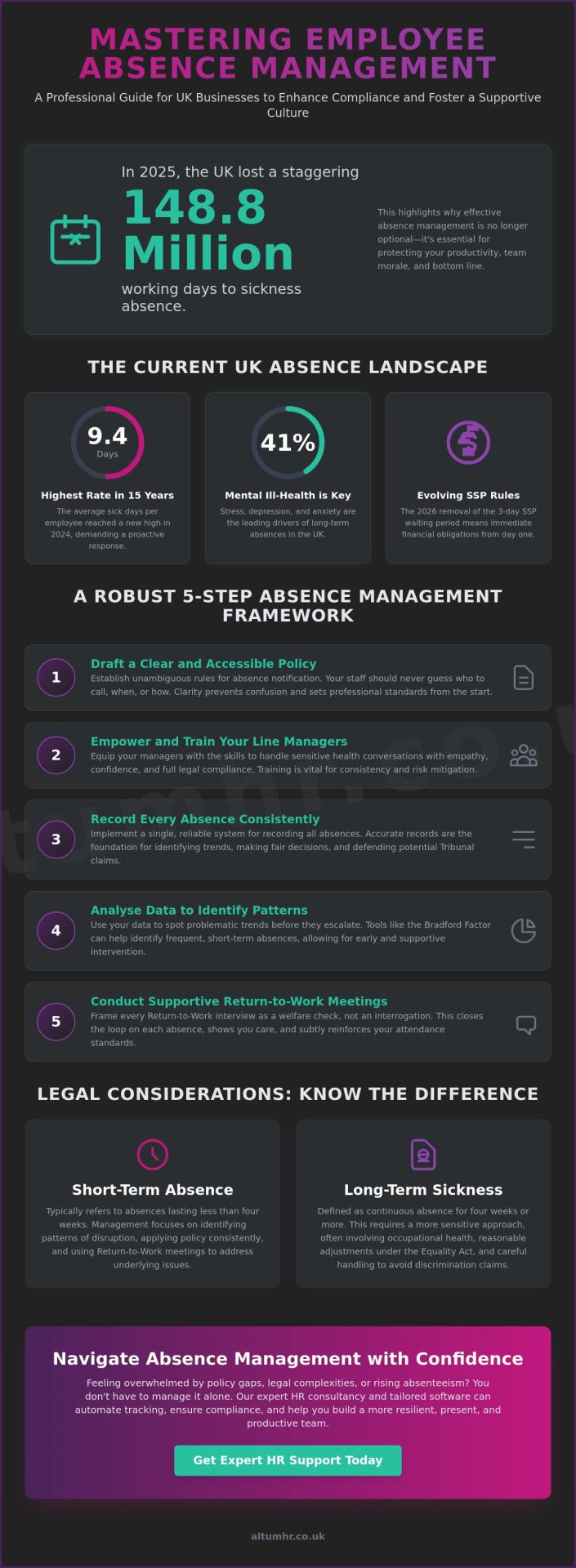
Did you know that 148.8 million working days were lost to sickness in the UK in 2025? This staggering figure explains why learning how to manage employee absence has become a top priority for businesses looking to protect their bottom line. You’re likely all too familiar with the frustration of shifting deadlines and the anxiety of wondering if your current policies would actually hold up in an Employment Tribunal.

It’s a delicate balance to strike, especially with the 2026 removal of SSP waiting days and the new 80% pay rules adding fresh layers of complexity to your payroll. We understand that you want to be a supportive employer without letting absenteeism erode your team’s morale or your company’s success. This guide provides professional strategies to help you maintain legal compliance whilst fostering a culture of health and accountability. We will explore the latest regulatory updates, practical tracking methods, and the art of the return-to-work meeting to help you build a more resilient, reliable workforce.

Key Takeaways

  • Establish a clear, written absence policy to set professional boundaries and ensure every team member understands their notification responsibilities within the organisation.
  • Learn the legal distinctions between short-term disruptions and long-term sickness to protect your business from costly Employment Tribunal claims.
  • Discover how to manage employee absence effectively by reframing return-to-work interviews as supportive welfare checks whilst maintaining firm attendance standards.
  • Equip your line managers with the training needed to navigate sensitive health conversations with both empathy and corporate authority.
  • Explore how tailored HR software and expert consultancy can automate your tracking processes and identify problematic attendance trends in real-time.

What is Absence Management and Why Does It Matter for UK SMEs?

When you consider the health of your organisation, attendance is one of the most visible indicators of engagement and stability. Absence management is the proactive process of tracking, understanding, and addressing employee time off to ensure business continuity. It isn’t just about ticking boxes or policing time sheets. Instead, it’s a sophisticated balance between supporting an employee’s wellbeing and protecting the productivity of the entire team. Understanding how to manage employee absence effectively means distinguishing between authorised leave, such as pre-booked holidays, and the unpredictable nature of unauthorised absenteeism.

The financial implications for UK SMEs are significant. Beyond the direct cost of Statutory Sick Pay (SSP), which rose to £123.25 per week for the 2026/27 tax year, there are indirect costs like management time, lost revenue, and temporary cover. With the abolition of the three-day waiting period under the Employment Rights Act 2025, employers now face immediate financial obligations from the very first day an employee is unwell. This shift makes a structured approach to absence management essential for maintaining fiscal health and operational momentum. By viewing these processes as a support mechanism rather than a disciplinary tool, you can build a culture where employees feel valued during genuine illness but understand the importance of their presence.

The Impact of Absenteeism on Team Morale

Absence Trends in the UK Workplace

Recent data indicates that the average number of sick days per employee reached 9.4 in 2024, marking the highest level in over 15 years. Mental ill-health, including anxiety, depression, and stress, remains the leading driver of long-term absence, accounting for 41% of cases according to recent industry reports. The 2026 environment requires a nuanced approach that acknowledges these health challenges whilst adapting to new flexible working rights and proactive fit note pilot schemes. Learning how to manage employee absence in this modern context involves moving away from rigid, traditional structures towards agile solutions that prioritise early intervention and tailored support.

Creating a Robust Absence Management Framework

Building a resilient organisation requires more than just reacting to phone calls on a Monday morning. To truly master how to manage employee absence, you need a structured framework that provides clarity for your staff and consistency for your leadership team. This begins with a comprehensive set of steps designed to move away from guesswork and towards data-driven, empathetic management.

  • Draft a clear policy: Your staff should never have to guess who to call or when to report their absence.
  • Empower your managers: Training is vital to ensure your team leaders can handle sensitive health disclosures with confidence and legal compliance.
  • Record everything: A consistent recording system allows you to spot trends before they become systemic issues.
  • Analyse the data: Use metrics like the Bradford Factor to identify patterns of frequent, short-term disruption fairly.
  • Close the loop: Conduct a Return to Work (RTW) interview after every instance of leave to show you care and to maintain professional standards.

Implementation is only half the battle. The real value lies in how these steps are communicated. When your team understands that these processes exist to support their wellbeing as much as the business’s productivity, you’ll see a natural shift in workplace culture. If you’re unsure where to start, an HR audit can help you identify and close any gaps in your current procedures.

The Essentials of an Absence Policy

A successful policy starts with “day one” notification rules. We recommend requiring a direct phone call to a manager by a specific time, rather than a text or email, as this allows for a brief welfare check and immediate resource planning. According to self-certification sick note rules, employees can provide their own account of illness for the first seven days of absence. Once this period is exceeded, you should refer to the UK government guidance on sick leave, which clarifies that a GP-issued “fit note” becomes a legal requirement. Having these benchmarks clearly outlined in your documentation ensures there is no ambiguity when an absence occurs.

Measuring Absence: The Bradford Factor

The Bradford Factor is a popular formula (S² x D = Points) used to highlight frequent, short-term absences which are often more disruptive to a business than a single long-term block of leave. In this calculation, “S” represents the number of separate absences and “D” is the total number of days away. While high scores are useful indicators, they should act as a trigger for “welfare meetings” rather than immediate disciplinary action. This data allows you to investigate root causes, such as underlying health issues or workplace stress, and link back to your wider Performance Management strategies where attendance impacts output. Using data in this way removes emotion from the process, ensuring every employee is treated with the same level of fairness and objectivity.

Navigating the legalities of sickness depends heavily on the duration and frequency of the time taken off. Whilst a single day of flu and a six-month recovery from surgery both count as sickness, the law treats them very differently. Short-term absence usually involves frequent, unconnected “odd days” that disrupt daily operations and resource planning. In contrast, long-term absence is generally defined as a continuous period of four weeks or more. Understanding how to manage employee absence in both scenarios is vital to avoid the common pitfalls that lead to costly legal disputes and damaged reputations.

When an absence becomes prolonged, the Equality Act 2010 often comes into play. If an employee’s condition meets the legal definition of a disability, you have a statutory duty to consider reasonable adjustments before even contemplating a dismissal. This might include phased returns, modified duties, or specialised equipment. Jumping to conclusions without seeking expert medical guidance from Occupational Health is a significant risk. Failing to follow a fair process can leave your business vulnerable to claims of disability discrimination or unfair dismissal, which can result in compensatory awards reaching over £123,543 in the current tax year.

Managing Frequent Short-Term Absence

Persistent, short-term absences are often harder to manage because they are unpredictable and can hide underlying issues. Your first step should always be identifying root causes. Is the employee suffering from a genuine health trend, or are there workplace issues like bullying or burnout at play? By using proven methods for managing absenteeism, you can establish clear “trigger points” in your policy. These triggers allow you to move from a welfare concern into formal disciplinary procedures when attendance levels become unsustainable. It’s about being fair but firm, ensuring that everyone is held to the same professional standard.

Handling Long-Term Sickness and Disability

Managing an employee who has been away for months requires a high degree of empathy and procedural precision. You have a duty to keep in touch, yet you must ensure this communication doesn’t cross the line into harassment. If it becomes clear that an employee cannot return to their role even with adjustments, you may need to consider a “capability” dismissal. This is always a last resort and requires a thorough investigation into the latest medical evidence. For these complex cases, securing specialist Employment Law Advice is the best way to ensure your organisation remains protected whilst treating the individual with the respect they deserve.

The Human Side: Return to Work Meetings and Culture

While frameworks and metrics provide the structure for your strategy, the way you interact with your people provides its heart. Understanding how to manage employee absence effectively requires a shift in perspective. You must view the Return to Work (RTW) meeting not as an interrogation, but as a supportive welfare check. This human-centric approach is vital for building trust and ensuring that employees feel valued rather than scrutinised when they are genuinely unwell. A compassionate conversation can often reveal hidden challenges, such as domestic stress or burnout, allowing for early intervention before a minor issue escalates into a long-term crisis.

These meetings also serve a secondary, more pragmatic purpose. The consistent application of RTW interviews acts as a gentle yet firm deterrent for non-genuine absences. When staff know that every period of leave is followed by a formal discussion, the appeal of a “duvet day” diminishes. However, you must handle these health-related matters with the utmost care regarding confidentiality and data protection. Health information is classified as “special category” data under GDPR, meaning it must be stored securely and only shared with those who strictly need to know. Maintaining this professional boundary ensures your organisation remains compliant whilst respecting individual privacy.

Conducting an Effective Return to Work Interview

An effective interview should be brief, private, and structured to ensure consistency across the organisation. We suggest following this simple checklist to keep the conversation productive:

  • Welcome back: Start by acknowledging their return and expressing that they were missed.
  • Check fitness: Confirm they are fully recovered and capable of performing their duties safely.
  • Update on news: Briefly catch them up on any key developments or changes that occurred during their absence.
  • Discuss adjustments: Explore if any temporary support or modifications are needed to help them settle back in.

To uncover underlying health trends without overstepping boundaries, focus your enquiry on how the condition impacts their specific work duties rather than asking for a clinical diagnosis. It is essential that these meetings are documented accurately. Clear records provide a vital paper trail that protects your business against future claims at Employment Tribunals by demonstrating that you have acted reasonably and supportively at every stage. If you find these conversations challenging to navigate, our absence management support can provide the expert coaching your managers need to lead with confidence.

Promoting Wellbeing to Prevent Absence

A proactive culture is your best defence against high absenteeism rates and is a vital component of a strategy for how to manage employee absence. By prioritising flexible working and a healthy work-life balance, you reduce the stress-related triggers that often lead to unplanned leave. SMEs don’t need massive budgets to make an impact; low-cost initiatives like regular one-to-one check-ins, signposting to mental health resources, or simply encouraging staff to take their full lunch breaks can foster a more resilient workforce. For a deeper look at your statutory obligations, securing reliable Employment Law Advice ensures your wellbeing initiatives remain aligned with current UK regulations.
How to Manage Employee Absence: A Comprehensive Guide for UK Employers

How Outsourced HR and Software Streamline Absence Management

Managing a growing workforce often means administrative tasks can become a bottleneck for business owners. When you’re focused on operational growth, tracking every sick day or dental appointment manually is simply not sustainable. Modern Employee Management Software transforms this burden by automating the tracking process and identifying problematic trends in real-time. This technology doesn’t just save time; it provides the objective data needed to understand how to manage employee absence without the bias or errors often found in traditional methods.

Beyond the software, having an expert consultant on-call provides a vital safety net for those difficult, high-stakes conversations. Whether you’re dealing with a long-term health issue or a suspicious pattern of Monday absences, professional guidance ensures you remain on the right side of the law. We often find that a comprehensive HR audit is the best starting point, as it identifies the specific “leaks” in productivity caused by inconsistent attendance. At Altum HR, we position ourselves as your strategic partner, handling the regulatory and administrative complexity whilst you focus on running your business.

The Power of Real-Time Absence Data

The days of messy, fragmented spreadsheets are over. Cloud-based systems offer a secure, centralised platform where data is always accessible and GDPR compliant. These systems can be configured to trigger automated alerts when an employee reaches a certain Bradford Factor score, preventing issues from escalating unnoticed. This proactive approach allows you to step in early with a welfare meeting rather than reacting only when a crisis occurs. These platforms also facilitate a self-service culture where employees can request leave and view their own attendance records, fostering a sense of transparency and individual accountability.

Expert Support for Complex Cases

There are times when internal management isn’t enough, particularly when facing complex medical cases or potential tribunal risks. This is where Fractional Outsourced HR becomes a catalyst for stability, providing executive-level strategy at a fraction of the cost of a full-time HR Director. Knowing that your absence processes are 100% compliant provides total peace of mind, allowing you to lead with confidence and empathy. If you’re ready to reduce absenteeism and protect your business productivity, speak to Altum HR today for a bespoke absence management strategy tailored to your organisation’s unique needs.

Transform Your Approach to Workplace Attendance

Managing attendance is a continuous journey that requires both structural precision and human empathy. You’ve seen how a robust policy, backed by clear data and supportive return-to-work conversations, can reduce the impact of sickness absence whilst protecting your operational momentum. By prioritising wellbeing and staying ahead of the 2026 legal updates, you safeguard your team’s morale and your organisation’s financial health. It’s about being proactive rather than reactive.

Mastering how to manage employee absence doesn’t have to be a source of constant anxiety for your leadership team. Whether you require expert Employment Law Advice, bespoke HR software solutions, or hands-on support for disciplinary hearings, we provide the calm reliability you need to navigate these complexities. Secure your business with expert Absence Management support from Altum HR and build a workforce that is resilient, engaged, and ready for future growth. With the right partnership, you can turn administrative hurdles into a vital catalyst for stability.

Frequently Asked Questions

Do I have to pay Statutory Sick Pay (SSP) from day one?

Yes, as of 6 April 2026, the three-day waiting period for SSP has been abolished. This means you must pay SSP from the very first qualifying day of an employee’s absence. It’s vital to ensure your payroll systems are updated to reflect this change and the current weekly rate of £123.25. Understanding these new rules is a fundamental part of learning how to manage employee absence in a compliant manner.

Can I contact an employee whilst they are off sick?

You are entitled to maintain reasonable contact with your staff during their absence to check on their wellbeing and discuss potential return dates. This communication should be supportive rather than pressured. We recommend establishing a preferred method and frequency of contact at the start of the absence to ensure the employee feels supported without feeling harassed. Clear communication helps maintain a positive relationship and facilitates a smoother return to the workplace.

What is the “Bradford Factor” and should I use it?

The Bradford Factor is a formula used to calculate a score based on the frequency and duration of an employee’s absences. It is particularly effective for identifying patterns of frequent, short-term leave which often cause the most operational disruption. Whilst it is a valuable tool for ensuring fairness, you shouldn’t use the score in isolation to trigger disciplinary action. Instead, use it as an objective indicator to start a welfare conversation and investigate underlying causes.

Can I dismiss an employee for being off sick too much?

Dismissal for persistent absence is possible, but it must be handled through a fair and thorough capability or disciplinary process. You must demonstrate that you have provided support, considered reasonable adjustments, and sought medical evidence before taking such a serious step. Learning how to manage employee absence legally is crucial here to avoid unfair dismissal claims. We always advise seeking professional guidance before moving towards a dismissal to ensure your process is robust.

How do I handle an employee who refuses to attend a return-to-work meeting?

If an employee refuses to attend, you should first explore their reasons, as there may be underlying anxieties about returning to their duties. Remind them that these meetings are a mandatory part of your company policy designed to ensure their health and safety at work. If the refusal persists without a valid medical reason, it may become a disciplinary matter. Handling this with a balance of empathy and corporate authority usually resolves the friction quickly.

What are “reasonable adjustments” for an employee with a long-term illness?

Reasonable adjustments are bespoke changes to a role or workplace that help an employee with a disability or long-term condition stay in work. This could include phased return schedules, altered start times, or providing specialised office equipment. Under the Equality Act 2010, you have a statutory duty to consider these changes. Implementing them effectively not only ensures compliance but also demonstrates a supportive culture that values the individual’s contribution to the organisation.

Does an employee need a doctor’s note for a two-day absence?

Employees do not need a doctor’s note for any absence lasting seven days or fewer. During this period, they can self-certify their illness by providing a written or verbal account of their incapacity. You can ask them to complete a self-certification form during their return-to-work meeting to maintain accurate records. A formal “fit note” from a GP is only a legal requirement once the absence reaches its eighth consecutive day, including weekends.

How can I manage absence caused by workplace stress or bullying?

When absence is linked to workplace culture, you must act quickly to investigate the root cause through your internal grievance procedures. It’s your responsibility to provide a safe working environment, so identifying and addressing the source of the stress is vital. This might involve mediation, additional training for managers, or disciplinary action against those responsible for the bullying. Proactive management in these cases prevents temporary absences from turning into long-term legal and operational challenges.

Josephine Broadstock

Article by

Josephine Broadstock

Josephine Broadstock is the Founder of Altum HR and a recognised thought leader in HR strategy and operational delivery. With a career grounded in employment law and hands-on business support, Josie has built a reputation for helping organisations move beyond transactional HR into truly strategic, commercially aligned people management.

At the core of Josie’s approach is a belief that HR should not sit in isolation—it should actively drive business performance. She works closely with business owners and leadership teams to understand how their organisations function in practice, not just on paper, enabling the design and implementation of people strategies that are both legally robust and operationally effective.

Josie specialises in translating complex employment law and HR challenges into clear, practical solutions that support growth, reduce risk, and improve organisational efficiency. Her work often focuses on bridging the gap between policy and execution—ensuring that processes are not only compliant but also embedded into day-to-day operations in a way that adds measurable value.

Through Altum HR, Josephine leads a team of highly qualified consultants who share her commitment to quality, personalisation, and commercial impact. She is particularly passionate about raising standards within the HR industry, advocating for a more consultative, expert-led approach that prioritises long-term business outcomes over quick fixes.

As an author, Josie shares insights on employment law developments, operational best practice, and real-world HR challenges, offering business leaders practical guidance they can apply immediately. Her content is designed to cut through complexity and provide clarity in an ever-evolving workplace landscape.

Disclaimer

Disclaimer
The content on this blog is provided for general informational and educational purposes only and does not constitute professional advice. While we strive to ensure information is accurate and up to date, we make no warranties or representations about the completeness, accuracy, reliability, suitability, or availability of the information, products, services, or related graphics contained on the blog. Any reliance you place on such information is strictly at your own risk. We accept no liability for any loss or damage arising from the use of this blog or reliance on its content.
No Professional Relationship
Use of this blog does not create a professional client relationship between you and Altum HR. For personalised advice, please consult a qualified professional in the relevant field.
Third‑Party Links and Content
This blog may contain links to third‑party websites, products, or services. Links are provided for convenience only and do not imply endorsement. We are not responsible for the content, privacy practices, or accuracy of third‑party sites and accept no liability for any loss or damage arising from their use.
Affiliate and Sponsored Content
Where applicable, we may receive compensation for products or services mentioned. We only recommend products we believe in, but you should perform your own due diligence before purchasing.
Intellectual Property
All content on this blog is protected by copyright unless otherwise stated. You may not reproduce, distribute, or create derivative works from our content without prior written permission.
Governing Law
This disclaimer and any dispute arising out of or in connection with the blog are governed by the laws of England and Wales.

Did you know that 148.8 million working days were lost to sickness in the UK in 2025? This staggering figure explains why learning how to manage employee absence has become a top priority for businesses looking to protect their bottom line. You’re likely all too familiar with the frustration of shifting deadlines and the anxiety of wondering if your current policies would actually hold up in an Employment Tribunal.

It’s a delicate balance to strike, especially with the 2026 removal of SSP waiting days and the new 80% pay rules adding fresh layers of complexity to your payroll. We understand that you want to be a supportive employer without letting absenteeism erode your team’s morale or your company’s success. This guide provides professional strategies to help you maintain legal compliance whilst fostering a culture of health and accountability. We will explore the latest regulatory updates, practical tracking methods, and the art of the return-to-work meeting to help you build a more resilient, reliable workforce.

Key Takeaways

  • Establish a clear, written absence policy to set professional boundaries and ensure every team member understands their notification responsibilities within the organisation.
  • Learn the legal distinctions between short-term disruptions and long-term sickness to protect your business from costly Employment Tribunal claims.
  • Discover how to manage employee absence effectively by reframing return-to-work interviews as supportive welfare checks whilst maintaining firm attendance standards.
  • Equip your line managers with the training needed to navigate sensitive health conversations with both empathy and corporate authority.
  • Explore how tailored HR software and expert consultancy can automate your tracking processes and identify problematic attendance trends in real-time.

What is Absence Management and Why Does It Matter for UK SMEs?

When you consider the health of your organisation, attendance is one of the most visible indicators of engagement and stability. Absence management is the proactive process of tracking, understanding, and addressing employee time off to ensure business continuity. It isn’t just about ticking boxes or policing time sheets. Instead, it’s a sophisticated balance between supporting an employee’s wellbeing and protecting the productivity of the entire team. Understanding how to manage employee absence effectively means distinguishing between authorised leave, such as pre-booked holidays, and the unpredictable nature of unauthorised absenteeism.

The financial implications for UK SMEs are significant. Beyond the direct cost of Statutory Sick Pay (SSP), which rose to £123.25 per week for the 2026/27 tax year, there are indirect costs like management time, lost revenue, and temporary cover. With the abolition of the three-day waiting period under the Employment Rights Act 2025, employers now face immediate financial obligations from the very first day an employee is unwell. This shift makes a structured approach to absence management essential for maintaining fiscal health and operational momentum. By viewing these processes as a support mechanism rather than a disciplinary tool, you can build a culture where employees feel valued during genuine illness but understand the importance of their presence.

The Impact of Absenteeism on Team Morale

Absence Trends in the UK Workplace

Recent data indicates that the average number of sick days per employee reached 9.4 in 2024, marking the highest level in over 15 years. Mental ill-health, including anxiety, depression, and stress, remains the leading driver of long-term absence, accounting for 41% of cases according to recent industry reports. The 2026 environment requires a nuanced approach that acknowledges these health challenges whilst adapting to new flexible working rights and proactive fit note pilot schemes. Learning how to manage employee absence in this modern context involves moving away from rigid, traditional structures towards agile solutions that prioritise early intervention and tailored support.

Creating a Robust Absence Management Framework

Building a resilient organisation requires more than just reacting to phone calls on a Monday morning. To truly master how to manage employee absence, you need a structured framework that provides clarity for your staff and consistency for your leadership team. This begins with a comprehensive set of steps designed to move away from guesswork and towards data-driven, empathetic management.

  • Draft a clear policy: Your staff should never have to guess who to call or when to report their absence.
  • Empower your managers: Training is vital to ensure your team leaders can handle sensitive health disclosures with confidence and legal compliance.
  • Record everything: A consistent recording system allows you to spot trends before they become systemic issues.
  • Analyse the data: Use metrics like the Bradford Factor to identify patterns of frequent, short-term disruption fairly.
  • Close the loop: Conduct a Return to Work (RTW) interview after every instance of leave to show you care and to maintain professional standards.

Implementation is only half the battle. The real value lies in how these steps are communicated. When your team understands that these processes exist to support their wellbeing as much as the business’s productivity, you’ll see a natural shift in workplace culture. If you’re unsure where to start, an HR audit can help you identify and close any gaps in your current procedures.

The Essentials of an Absence Policy

A successful policy starts with “day one” notification rules. We recommend requiring a direct phone call to a manager by a specific time, rather than a text or email, as this allows for a brief welfare check and immediate resource planning. According to self-certification sick note rules, employees can provide their own account of illness for the first seven days of absence. Once this period is exceeded, you should refer to the UK government guidance on sick leave, which clarifies that a GP-issued “fit note” becomes a legal requirement. Having these benchmarks clearly outlined in your documentation ensures there is no ambiguity when an absence occurs.

Measuring Absence: The Bradford Factor

The Bradford Factor is a popular formula (S² x D = Points) used to highlight frequent, short-term absences which are often more disruptive to a business than a single long-term block of leave. In this calculation, “S” represents the number of separate absences and “D” is the total number of days away. While high scores are useful indicators, they should act as a trigger for “welfare meetings” rather than immediate disciplinary action. This data allows you to investigate root causes, such as underlying health issues or workplace stress, and link back to your wider Performance Management strategies where attendance impacts output. Using data in this way removes emotion from the process, ensuring every employee is treated with the same level of fairness and objectivity.

Navigating the legalities of sickness depends heavily on the duration and frequency of the time taken off. Whilst a single day of flu and a six-month recovery from surgery both count as sickness, the law treats them very differently. Short-term absence usually involves frequent, unconnected “odd days” that disrupt daily operations and resource planning. In contrast, long-term absence is generally defined as a continuous period of four weeks or more. Understanding how to manage employee absence in both scenarios is vital to avoid the common pitfalls that lead to costly legal disputes and damaged reputations.

When an absence becomes prolonged, the Equality Act 2010 often comes into play. If an employee’s condition meets the legal definition of a disability, you have a statutory duty to consider reasonable adjustments before even contemplating a dismissal. This might include phased returns, modified duties, or specialised equipment. Jumping to conclusions without seeking expert medical guidance from Occupational Health is a significant risk. Failing to follow a fair process can leave your business vulnerable to claims of disability discrimination or unfair dismissal, which can result in compensatory awards reaching over £123,543 in the current tax year.

Managing Frequent Short-Term Absence

Persistent, short-term absences are often harder to manage because they are unpredictable and can hide underlying issues. Your first step should always be identifying root causes. Is the employee suffering from a genuine health trend, or are there workplace issues like bullying or burnout at play? By using proven methods for managing absenteeism, you can establish clear “trigger points” in your policy. These triggers allow you to move from a welfare concern into formal disciplinary procedures when attendance levels become unsustainable. It’s about being fair but firm, ensuring that everyone is held to the same professional standard.

Handling Long-Term Sickness and Disability

Managing an employee who has been away for months requires a high degree of empathy and procedural precision. You have a duty to keep in touch, yet you must ensure this communication doesn’t cross the line into harassment. If it becomes clear that an employee cannot return to their role even with adjustments, you may need to consider a “capability” dismissal. This is always a last resort and requires a thorough investigation into the latest medical evidence. For these complex cases, securing specialist Employment Law Advice is the best way to ensure your organisation remains protected whilst treating the individual with the respect they deserve.

The Human Side: Return to Work Meetings and Culture

While frameworks and metrics provide the structure for your strategy, the way you interact with your people provides its heart. Understanding how to manage employee absence effectively requires a shift in perspective. You must view the Return to Work (RTW) meeting not as an interrogation, but as a supportive welfare check. This human-centric approach is vital for building trust and ensuring that employees feel valued rather than scrutinised when they are genuinely unwell. A compassionate conversation can often reveal hidden challenges, such as domestic stress or burnout, allowing for early intervention before a minor issue escalates into a long-term crisis.

These meetings also serve a secondary, more pragmatic purpose. The consistent application of RTW interviews acts as a gentle yet firm deterrent for non-genuine absences. When staff know that every period of leave is followed by a formal discussion, the appeal of a “duvet day” diminishes. However, you must handle these health-related matters with the utmost care regarding confidentiality and data protection. Health information is classified as “special category” data under GDPR, meaning it must be stored securely and only shared with those who strictly need to know. Maintaining this professional boundary ensures your organisation remains compliant whilst respecting individual privacy.

Conducting an Effective Return to Work Interview

An effective interview should be brief, private, and structured to ensure consistency across the organisation. We suggest following this simple checklist to keep the conversation productive:

  • Welcome back: Start by acknowledging their return and expressing that they were missed.
  • Check fitness: Confirm they are fully recovered and capable of performing their duties safely.
  • Update on news: Briefly catch them up on any key developments or changes that occurred during their absence.
  • Discuss adjustments: Explore if any temporary support or modifications are needed to help them settle back in.

To uncover underlying health trends without overstepping boundaries, focus your enquiry on how the condition impacts their specific work duties rather than asking for a clinical diagnosis. It is essential that these meetings are documented accurately. Clear records provide a vital paper trail that protects your business against future claims at Employment Tribunals by demonstrating that you have acted reasonably and supportively at every stage. If you find these conversations challenging to navigate, our absence management support can provide the expert coaching your managers need to lead with confidence.

Promoting Wellbeing to Prevent Absence

A proactive culture is your best defence against high absenteeism rates and is a vital component of a strategy for how to manage employee absence. By prioritising flexible working and a healthy work-life balance, you reduce the stress-related triggers that often lead to unplanned leave. SMEs don’t need massive budgets to make an impact; low-cost initiatives like regular one-to-one check-ins, signposting to mental health resources, or simply encouraging staff to take their full lunch breaks can foster a more resilient workforce. For a deeper look at your statutory obligations, securing reliable Employment Law Advice ensures your wellbeing initiatives remain aligned with current UK regulations.

How to Manage Employee Absence: A Comprehensive Guide for UK Employers

How Outsourced HR and Software Streamline Absence Management

Managing a growing workforce often means administrative tasks can become a bottleneck for business owners. When you’re focused on operational growth, tracking every sick day or dental appointment manually is simply not sustainable. Modern Employee Management Software transforms this burden by automating the tracking process and identifying problematic trends in real-time. This technology doesn’t just save time; it provides the objective data needed to understand how to manage employee absence without the bias or errors often found in traditional methods.

Beyond the software, having an expert consultant on-call provides a vital safety net for those difficult, high-stakes conversations. Whether you’re dealing with a long-term health issue or a suspicious pattern of Monday absences, professional guidance ensures you remain on the right side of the law. We often find that a comprehensive HR audit is the best starting point, as it identifies the specific “leaks” in productivity caused by inconsistent attendance. At Altum HR, we position ourselves as your strategic partner, handling the regulatory and administrative complexity whilst you focus on running your business.

The Power of Real-Time Absence Data

The days of messy, fragmented spreadsheets are over. Cloud-based systems offer a secure, centralised platform where data is always accessible and GDPR compliant. These systems can be configured to trigger automated alerts when an employee reaches a certain Bradford Factor score, preventing issues from escalating unnoticed. This proactive approach allows you to step in early with a welfare meeting rather than reacting only when a crisis occurs. These platforms also facilitate a self-service culture where employees can request leave and view their own attendance records, fostering a sense of transparency and individual accountability.

Expert Support for Complex Cases

There are times when internal management isn’t enough, particularly when facing complex medical cases or potential tribunal risks. This is where Fractional Outsourced HR becomes a catalyst for stability, providing executive-level strategy at a fraction of the cost of a full-time HR Director. Knowing that your absence processes are 100% compliant provides total peace of mind, allowing you to lead with confidence and empathy. If you’re ready to reduce absenteeism and protect your business productivity, speak to Altum HR today for a bespoke absence management strategy tailored to your organisation’s unique needs.

Transform Your Approach to Workplace Attendance

Managing attendance is a continuous journey that requires both structural precision and human empathy. You’ve seen how a robust policy, backed by clear data and supportive return-to-work conversations, can reduce the impact of sickness absence whilst protecting your operational momentum. By prioritising wellbeing and staying ahead of the 2026 legal updates, you safeguard your team’s morale and your organisation’s financial health. It’s about being proactive rather than reactive.

Mastering how to manage employee absence doesn’t have to be a source of constant anxiety for your leadership team. Whether you require expert Employment Law Advice, bespoke HR software solutions, or hands-on support for disciplinary hearings, we provide the calm reliability you need to navigate these complexities. Secure your business with expert Absence Management support from Altum HR and build a workforce that is resilient, engaged, and ready for future growth. With the right partnership, you can turn administrative hurdles into a vital catalyst for stability.

Frequently Asked Questions

Do I have to pay Statutory Sick Pay (SSP) from day one?

Yes, as of 6 April 2026, the three-day waiting period for SSP has been abolished. This means you must pay SSP from the very first qualifying day of an employee’s absence. It’s vital to ensure your payroll systems are updated to reflect this change and the current weekly rate of £123.25. Understanding these new rules is a fundamental part of learning how to manage employee absence in a compliant manner.

Can I contact an employee whilst they are off sick?

You are entitled to maintain reasonable contact with your staff during their absence to check on their wellbeing and discuss potential return dates. This communication should be supportive rather than pressured. We recommend establishing a preferred method and frequency of contact at the start of the absence to ensure the employee feels supported without feeling harassed. Clear communication helps maintain a positive relationship and facilitates a smoother return to the workplace.

What is the “Bradford Factor” and should I use it?

The Bradford Factor is a formula used to calculate a score based on the frequency and duration of an employee’s absences. It is particularly effective for identifying patterns of frequent, short-term leave which often cause the most operational disruption. Whilst it is a valuable tool for ensuring fairness, you shouldn’t use the score in isolation to trigger disciplinary action. Instead, use it as an objective indicator to start a welfare conversation and investigate underlying causes.

Can I dismiss an employee for being off sick too much?

Dismissal for persistent absence is possible, but it must be handled through a fair and thorough capability or disciplinary process. You must demonstrate that you have provided support, considered reasonable adjustments, and sought medical evidence before taking such a serious step. Learning how to manage employee absence legally is crucial here to avoid unfair dismissal claims. We always advise seeking professional guidance before moving towards a dismissal to ensure your process is robust.

How do I handle an employee who refuses to attend a return-to-work meeting?

If an employee refuses to attend, you should first explore their reasons, as there may be underlying anxieties about returning to their duties. Remind them that these meetings are a mandatory part of your company policy designed to ensure their health and safety at work. If the refusal persists without a valid medical reason, it may become a disciplinary matter. Handling this with a balance of empathy and corporate authority usually resolves the friction quickly.

What are “reasonable adjustments” for an employee with a long-term illness?

Reasonable adjustments are bespoke changes to a role or workplace that help an employee with a disability or long-term condition stay in work. This could include phased return schedules, altered start times, or providing specialised office equipment. Under the Equality Act 2010, you have a statutory duty to consider these changes. Implementing them effectively not only ensures compliance but also demonstrates a supportive culture that values the individual’s contribution to the organisation.

Does an employee need a doctor’s note for a two-day absence?

Employees do not need a doctor’s note for any absence lasting seven days or fewer. During this period, they can self-certify their illness by providing a written or verbal account of their incapacity. You can ask them to complete a self-certification form during their return-to-work meeting to maintain accurate records. A formal “fit note” from a GP is only a legal requirement once the absence reaches its eighth consecutive day, including weekends.

How can I manage absence caused by workplace stress or bullying?

When absence is linked to workplace culture, you must act quickly to investigate the root cause through your internal grievance procedures. It’s your responsibility to provide a safe working environment, so identifying and addressing the source of the stress is vital. This might involve mediation, additional training for managers, or disciplinary action against those responsible for the bullying. Proactive management in these cases prevents temporary absences from turning into long-term legal and operational challenges.

Josephine Broadstock

Article by

Josephine Broadstock

Josephine Broadstock is the Founder of Altum HR and a recognised thought leader in HR strategy and operational delivery. With a career grounded in employment law and hands-on business support, Josie has built a reputation for helping organisations move beyond transactional HR into truly strategic, commercially aligned people management.

At the core of Josie’s approach is a belief that HR should not sit in isolation—it should actively drive business performance. She works closely with business owners and leadership teams to understand how their organisations function in practice, not just on paper, enabling the design and implementation of people strategies that are both legally robust and operationally effective.

Josie specialises in translating complex employment law and HR challenges into clear, practical solutions that support growth, reduce risk, and improve organisational efficiency. Her work often focuses on bridging the gap between policy and execution—ensuring that processes are not only compliant but also embedded into day-to-day operations in a way that adds measurable value.

Through Altum HR, Josephine leads a team of highly qualified consultants who share her commitment to quality, personalisation, and commercial impact. She is particularly passionate about raising standards within the HR industry, advocating for a more consultative, expert-led approach that prioritises long-term business outcomes over quick fixes.

As an author, Josie shares insights on employment law developments, operational best practice, and real-world HR challenges, offering business leaders practical guidance they can apply immediately. Her content is designed to cut through complexity and provide clarity in an ever-evolving workplace landscape.

Disclaimer

Disclaimer
The content on this blog is provided for general informational and educational purposes only and does not constitute professional advice. While we strive to ensure information is accurate and up to date, we make no warranties or representations about the completeness, accuracy, reliability, suitability, or availability of the information, products, services, or related graphics contained on the blog. Any reliance you place on such information is strictly at your own risk. We accept no liability for any loss or damage arising from the use of this blog or reliance on its content.
No Professional Relationship
Use of this blog does not create a professional client relationship between you and Altum HR. For personalised advice, please consult a qualified professional in the relevant field.
Third‑Party Links and Content
This blog may contain links to third‑party websites, products, or services. Links are provided for convenience only and do not imply endorsement. We are not responsible for the content, privacy practices, or accuracy of third‑party sites and accept no liability for any loss or damage arising from their use.
Affiliate and Sponsored Content
Where applicable, we may receive compensation for products or services mentioned. We only recommend products we believe in, but you should perform your own due diligence before purchasing.
Intellectual Property
All content on this blog is protected by copyright unless otherwise stated. You may not reproduce, distribute, or create derivative works from our content without prior written permission.
Governing Law
This disclaimer and any dispute arising out of or in connection with the blog are governed by the laws of England and Wales.

Call now for instant HR advice on 0800 048 5764 or WhatsApp 07432 275612.

How to Manage Employee Absence: A Comprehensive Guide for UK Employers

Book an HR Consultation

From HR advice, policies to Employment Law, Redundancy Support and Employee Contracts - we can help. Leave your details below and we'll be in touch.


Your data will be processed inline with our privacy policy. We respect your right to privacy and continuously strive to ensure that all data that we collect and store is done so securely and is properly protected.